Last updated: June 2026.
Two dorm beds in Chiang Mai run $20–30 a night combined. A private room runs $24–38 — sometimes less. The dorm-vs-private gap that scares most couples into overspending when backpacking for couples is often just a few dollars, or doesn’t exist at all.
We learned this on our first night traveling together: a private room with a rooftop bar, $54 total, while six other travelers two floors down were splitting $18 dorm beds. That’s the night the math clicked.
I’d assumed going from solo to traveling with a partner meant one of two things: either keep suffering through $18-a-night dorm beds for the sake of the budget, or upgrade to proper hotels and watch the whole thing cost double. Turns out there’s a third option that most couple travel articles don’t bother explaining, because the math is almost embarrassingly simple once you see it.
This post is the debrief I wish I’d had before our first long trip together. Real 2026 numbers. Three accommodation tiers with decision triggers. Destination-specific breakdowns for Thailand, Bali, and Barcelona. A money-splitting system that doesn’t get weird. And a practical toolkit for not becoming that couple on the overnight bus who doesn’t speak for six hours.
If you’re here for romance inspiration, wrong article. If you want a system you can actually book from — keep reading.
This is one piece of the broader backpacking hacks system; this post handles the couple-specific math, the hacks guide covers everything else.
This post contains affiliate links, including Amazon links. As an Amazon Associate, I earn from qualifying purchases at no extra cost to you. Learn more.
Table of Contents
- The Two-Person Upgrade Math
- The 3-Tier Accommodation System
- Destination Playbooks
- How to Split Costs Without It Getting Weird
- When You Shouldn’t Backpack Together (Yet)
- Sample 30-Day Budget
- 5 Biggest Booking Mistakes
- The Relationship Toolkit
- The 7-Point Framework
- FAQ
- What to Book First
The Two-Person Upgrade Math (The Thing Nobody Explains)
That Chiang Mai gap from the intro isn’t a one-off. Two dorm beds usually cost the same as — or more than — one private room split between two people, and it holds across most of Southeast Asia and Europe’s mid-tier cities too.
Look at the numbers across the route:
| Destination | Dorm per person/night | 2x dorm total | Private room total | Private per person | Saving per person |
|---|---|---|---|---|---|
| Bangkok | $14–18 | $28–36 | $38–52 | $19–26 | Break-even to slight premium |
| Chiang Mai | $10–15 | $20–30 | $24–38 | $12–19 | Often cheaper than dorm |
| Ubud, Bali | $12–18 | $24–36 | $30–48 | $15–24 | Comparable to slight premium |
| Canggu, Bali | $14–20 | $28–40 | $35–55 | $17–27 | Comparable |
| Barcelona | $28–38 | $56–76 | $65–95 | $32–47 | Usually cheaper than dorm |
Quick reality check: on Booking.com, filter for 2 adults and compare dorm vs private room prices side by side — in most cities, the gap is smaller than you think.
In Chiang Mai and Barcelona especially, a private room per person costs less than a dorm bed — while you get your own bathroom, a door that locks, and the ability to talk to each other after 10pm without someone shushing you. The upgrade is free. You’re just unlocking it.
The couple advantage compounds further when you add villa splits (see the Bali villa rental guide — 3–5 people splitting a whole villa in Bali for $25–40 per person per night) and Airbnb apartments (where a one-bedroom in Barcelona’s Gràcia neighborhood can run €65–85/night total, cheaper per person than two hostel bunks).
The math in one sentence: as a couple, your accommodation unit is a private room — not two beds. Price it that way from the start.
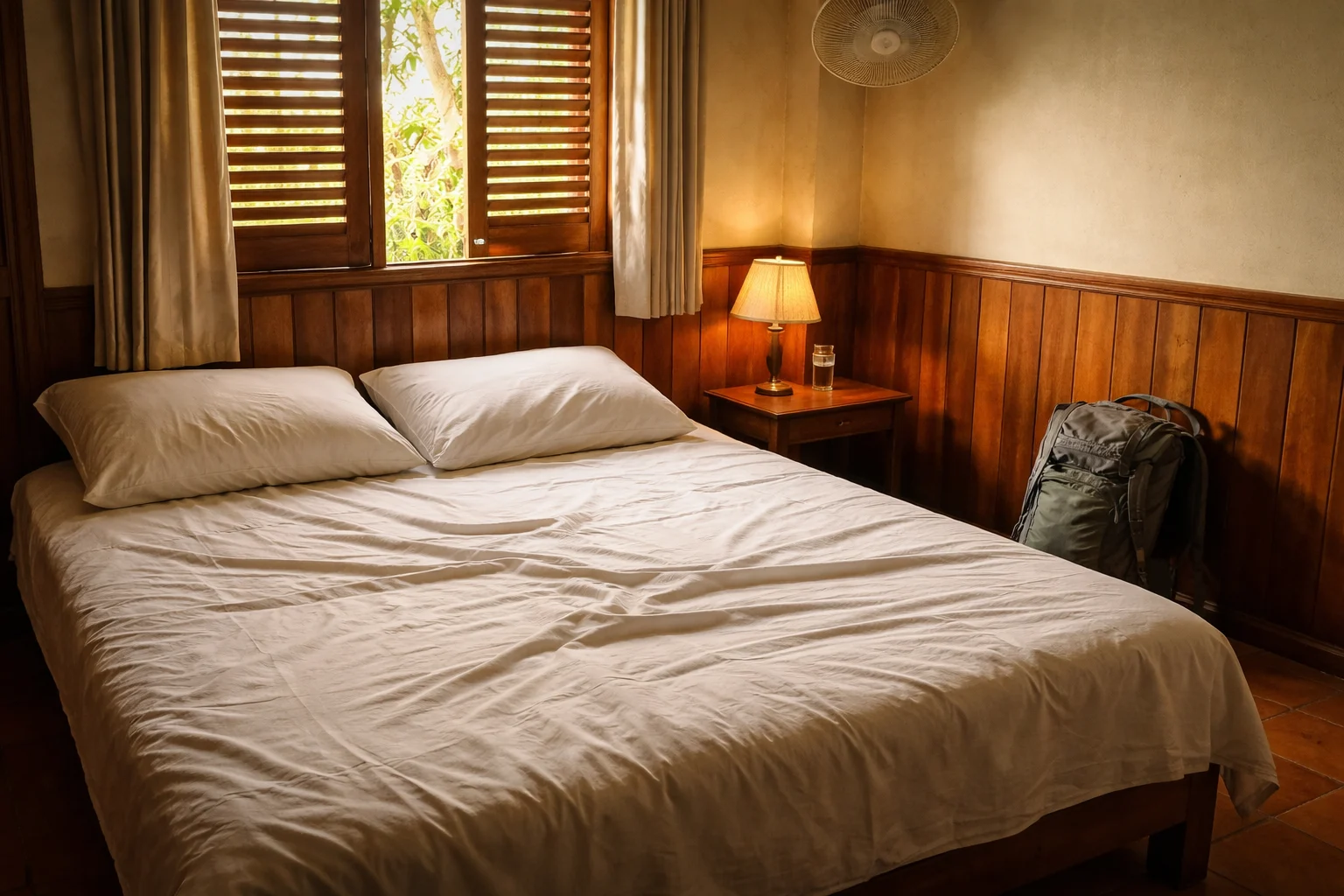
Accommodation for Couples Backpacking: The 3-Tier System
Most couple travel content either defaults to “book a private room in a hostel” or jumps straight to boutique hotels. The actual system has three tiers, and knowing when to use each one is what keeps the budget in check across a long trip.
Tier 1 — Hostel Private Room (Your Default)
Getting hostels for couples right is the single most important skill in this whole system. A private room in a well-rated hostel gives you the best of both worlds: your own space plus the social infrastructure — common areas, rooftop bars, communal dinners, other travelers — that dorms were never exclusively about. You don’t lose the backpacker energy. You just stop paying for the privilege of other people’s snoring.
Booking timing: in SE Asia, book 1–3 days ahead for flexibility. In Barcelona during high season (June–September), book 4–7 days ahead or private rooms disappear fast.
What to filter for on Booking.com or Hostelworld: 8.0+ rating, “couples-friendly” or “great for couples” tag, en-suite bathroom if available, not tagged as party hostel, private room with double or queen — not two singles pushed together (check the photos). Read recent reviews specifically for noise and bed comfort.
Use this tier when: you’re in a city for 1–4 nights, you want to meet other travelers, or the nightly rate difference from an Airbnb isn’t worth the convenience loss.
Private hostel rooms at 8.0+ are easiest to find on Booking.com or Hostelworld — filter for double room, en-suite, and check the couple reviews.
Tier 2 — Airbnb or Apartment Stay
When you’re staying 5+ nights in one place, a private apartment almost always wins on cost and quality. You get a kitchen (breakfast and some dinners cooked = significant daily savings), actual privacy, a neighborhood feel instead of tourist-zone hostel, and often more space than a hotel room at the same price.
Use this tier when: you’re slow-traveling (5+ nights), you need to decompress after intense transit or a long stretch of hostel nights, or you’re in a city where hostel private rooms are genuinely expensive (Barcelona in high season, Seminyak in Bali).
Watch for: minimum stay requirements, cleaning fees that inflate short stays, and listings with no recent reviews. In Barcelona specifically, check that the listing has a tourist license number — unlicensed apartments can get shut down mid-stay.
Tier 3 — Villa Split or Strategic Boutique Night
A villa split is one of the most underused moves in a couple’s travel toolkit. In Bali especially, a two-bedroom or three-bedroom private villa with pool often runs $80–130/night total — meaning two couples or a couple plus one friend pays $25–45 per person. That’s cheaper than a hostel private room, and you have a pool.
Use this tier when: you’re staying 3+ nights in one place and can coordinate with one or two other travelers (meetable via hostel the night before), or when you’ve just finished a long travel stretch and need a genuine reset. One or two nights in a nice place costs less than you think when split and does more for the relationship than a week of budget compromise.
Here’s how the three tiers stack up against each other:
| Tier | Best for | Decision trigger | Primary platform |
|---|---|---|---|
| Hostel private room | 1–4 nights, social energy, flexibility | Default. Start here unless another tier wins clearly. | Hostelworld, Booking.com |
| Airbnb / apartment | 5+ nights, slow travel, cooking, decompression | Stay ≥5 nights OR hostel private rooms >$55/night total | Airbnb, Booking.com apartments |
| Villa split / boutique | Reset nights, Bali long stays, reward after hard transit | Can find 1–2 split partners OR post-transit recovery needed | Airbnb (villas), Booking.com boutiques |
Once you know which tier you’re in, the harder calls are usually within a tier, not between them.
If you’re weighing private hostel rooms against boutique hotels or villas for a specific trip, see what is a boutique hotel for the full comparison.
Destination Playbooks
Where you go determines how much the couple advantage is worth. Here’s how the math and the experience actually play out across the three destinations that come up most in searches around backpacking for couples.
Thailand for Couples
Thailand is where the couple upgrade math works best. Private room hostels in Chiang Mai in particular are absurdly good value — you can regularly find 8.5-rated places with private en-suite doubles for ฿700–1,000/night (roughly $20–28 total), which makes the per-person cost lower than a dorm bed almost everywhere in Europe. Bangkok is slightly pricier in the Sukhumvit area, but Silom and Ari neighborhoods have strong mid-tier hostel options with private rooms in the $38–52 range.
For longer stays in the islands — Koh Lanta, Koh Phangan off-peak — look at bungalow rentals direct rather than through Airbnb. A beach bungalow for two with a fan runs $25–45/night in low season, with AC options at $40–65. This sits between Tier 1 and Tier 2 in practice.
Couple-specific tip for Thailand: the social scene in Thai hostels is genuinely good, but it’s hostel-social — communal dinners, bar crawls, cheap buckets. If one of you wants quiet evenings, that tension surfaces here faster than in Europe. Plan for 2–3 hostel-social nights per week and the rest quieter — it keeps both of you happy.
Sample nightly budget (two people): Accommodation $28–52 · Food $20–35 · Transport $8–18 · Activities $0–25 · Total: $56–130/day for two ($28–65 per person)
Bali for Couples
Bali flips the equation entirely: villa economics make the couple math better here than almost anywhere else on the route. A private villa with a pool, often with breakfast included, can be found in Ubud or Canggu for $50–80/night total in shoulder season — meaning two people pay $25–40 each. That’s less than a hostel private room in most European cities, and you have a pool and someone bringing you coffee in the morning.
The two main bases for backpacker-style travel in Bali are Canggu (digital nomad-heavy, surf, strong café culture, good nightlife) and Ubud (jungle, rice paddies, yoga, quieter energy). They have genuinely different vibes — if you can, do both. Canggu for the first stretch if you want social energy, Ubud for a few nights to decompress.
On the villa split: Canggu especially has a culture of travelers splitting villas. Spend one night in a hostel common area mentioning you’re looking to split a villa for the next few days — you’ll find people. Apps like Splitwise help manage the cost division without it getting awkward.
Sample nightly budget (two people): Villa split $50–80 · Food $18–30 · Scooter rental $8–12 · Activities $0–30 · Total: $76–152/day for two ($38–76 per person)
One practical mistake almost everyone makes before that first Bali week: sunscreen.
The sunscreen that doesn’t leave you looking like a ghost in every photo.
Abib Airy Sunstick, SPF 50+ — no white cast, reef-safe, passes the reef rules in both Bali and Thailand. Worth packing rather than buying there — locals don’t use reef-safe sunscreen, so what you’ll find locally is imported, marked up, and often sold out by peak season.
Barcelona for Couples
Barcelona is where the math shifts but still works. Hostel private rooms here run €65–95/night total — which sounds expensive until you realize a basic hotel is €110–160 and still gives you breakfast in a depressing lobby. The hostel private room at a well-rated place in Gràcia or Eixample includes rooftop access, a social scene, and central location. Per person it’s cheaper than either of you would pay solo for a comparable option.
For stays of 5+ nights, an Airbnb one-bedroom in Gràcia or Poble Sec runs €70–100/night (check for tourist license in the listing description — it’s a legal requirement and its absence is a red flag). This beats the hostel private room price and gives you a kitchen, which matters in Barcelona because the gap between supermarket food and tourist-restaurant food is enormous.
Neighborhood note: Gothic Quarter is central but loud, touristy, and overpriced for what you get. Gràcia is 15 minutes north by metro — quieter, more local, better value on accommodation, and has better neighborhood restaurants. Eixample is good for mid-trip if you want a clean, walkable base.
Sample nightly budget (two people): Accommodation €65–100 · Food €30–55 · Transport €10–20 · Activities €0–40 · Total: €105–215/day for two (€52–107 per person)
How to Split Costs Without It Getting Weird
The 50/50 default sounds fair until one of you earns significantly more than the other, or one of you wants a nicer room and the other doesn’t. Here are three systems that actually work — pick one before the trip, not mid-argument at a Thai ATM.
System 1: True 50/50 (Works When Incomes Are Similar)
Everything shared goes in a joint pot — accommodation, transport, shared meals, activities you both do. Anything personal (solo drinks, individual shopping, that massage you got alone) comes from your own money. Simple, clean, no resentment if incomes are within 20–30% of each other.
System 2: Proportional Split (Works When Incomes Differ)
Each person contributes to shared costs proportionally to their income. If one earns $80k and the other $50k, the split is roughly 61/39 rather than 50/50. This feels fairer over a long trip when one person is visibly stretching and the other isn’t. Agree on the ratio before you leave. Put it in a shared note — a Splitwise running total works well here so neither person has to remember it mid-trip.
System 3: The Trip Kitty (Works for Most Couples)
Both of you put an agreed daily amount into a shared account or Splitwise pool (e.g., $60/day each = $120/day budget). All shared expenses come out of that. Anything left at the end of the week rolls over. Personal spending is completely separate and no one’s business. This is the system that creates the least friction in practice — no “you spent how much on that?” conversations — shared costs are shared, personal costs are personal.
One thing to agree on before you leave: what counts as “shared” vs “personal.” Food when you’re together = shared. One person’s massage = personal. Museum entry when you both go = shared. The conversation is five minutes and saves ten arguments.
When You Shouldn’t Backpack Together (Yet)
This section exists because most couple travel content pretends the answer is always “yes, go for it.” Sometimes it isn’t — and we learned that the hard way on a trip where our budget expectations were a full €40/day apart. Knowing the signs saves the trip and possibly the relationship.
- Your budgets are genuinely incompatible. One person’s floor is the other person’s ceiling. If one of you is genuinely comfortable in a dorm and the other genuinely can’t sleep without air conditioning, no system resolves that — it just surfaces as resentment every night.
- You haven’t had a real disagreement about money yet. A long trip is a bad place to discover you have fundamentally different relationships with spending. A weekend trip first where you split costs for real is worth doing before a 4-week commitment.
- One person is significantly less experienced and anxious about it. Not inexperienced — anxious. Inexperienced is fine; the learning curve is part of it. But if one partner is quietly dreading the whole thing and hasn’t said so, that surfaces badly in week two.
- You haven’t agreed on pace. Moving every 2–3 days vs. staying 1–2 weeks in each place is not a small difference. It affects costs, energy, social life, and how tired you are. Align on this before you book.
Reality check: a trip that goes badly because you weren’t ready costs more than just the money. It’s worth doing a shorter test trip first if there’s genuine uncertainty. A 10-day trip to one destination tells you most of what you need to know.

Sample 30-Day Budget: Southeast Asia + Barcelona
Here’s what all of those systems actually look like once the numbers come together. This is close to what we actually spent on a similar route — 3 weeks in Thailand/Bali followed by 1 week in Barcelona. These are actual 2026 numbers, not aspirational ones.
| Leg | Duration | Accommodation (total/night, 2 people) | Daily spend (2 people) | Leg total |
|---|---|---|---|---|
| Bangkok (hostel private) | 4 nights | $48–54 | $95–130 | $380–520 |
| Chiang Mai (hostel private) | 5 nights | $26–36 | $70–100 | $350–500 |
| Koh Lanta (bungalow, direct) | 5 nights | $35–55 | $75–110 | $375–550 |
| Canggu, Bali (villa split) | 5 nights | $50–70 | $90–130 | $450–650 |
| Ubud, Bali (guesthouse) | 4 nights | $40–60 | $80–115 | $320–460 |
| Barcelona (Airbnb, Gràcia) | 7 nights | €70–95 | €130–185 | €910–1,295 |
Note: Barcelona row is in EUR. At current rates (~1.08), €910–1,295 ≈ $980–1,400.
30-day total estimate (excluding flights): $2,800–4,200 for two people — roughly $1,400–2,100 per person, or $47–70/day each. Flights from a Western city to Bangkok and back from Barcelona run $700–1,100 per person depending on timing and flexibility.
That’s a 4-week trip to Southeast Asia and Europe for $2,100–3,200 per person all-in. Solo travelers doing the same itinerary in dorms pay $1,600–2,600 — meaning the couple premium, if there is one, is less than $500 per person across the whole trip, and you had private rooms and a villa the entire time.
The 5 Biggest Booking Mistakes Couples Make
Most of the gap between couples who travel well and couples who overspend isn’t the destination — it’s these five mistakes, all avoidable, all made before the trip even starts.
- Comparing hotel prices instead of hostel private rooms. Hotels are priced for tourists expecting tourist amenities. Hostel private rooms get you the same bed and bathroom without the markup — see the upgrade math above.
- Pricing accommodation per person instead of per room. A $60 room split two ways is $30 each — cheaper than most dorm beds. Pricing it as “$60 for me” before realizing it’s shared is how couples talk themselves into worse options.
- Booking apartments for stays under 5 nights. Cleaning fees and check-in friction eat the savings on short stays. Apartments win at 5+ nights — see Tier 2 above.
- Ignoring cleaning fees on Airbnb. A $35/night listing with a $60 cleaning fee for a 2-night stay is actually $65/night. Always check the total before comparing.
- Booking non-refundable rates too early. Couple itineraries change more than solo ones — one person gets sick, plans shift. Free cancellation costs a few dollars more per night and pays for itself the first time you need it.
The Relationship Toolkit (Systems, Not Advice)
Every “how to not fight while traveling” article gives you the same three platitudes: communicate, compromise, be patient. That’s not a system — that’s what people say when they don’t have one. Three systems that actually hold up on a long trip:
The Planner / Executor Split
One person researches and decides the next destination or accommodation; the other handles the logistics of getting there (transport booking, bags, check-in). Roles rotate every 3–5 days. This stops the classic dynamic where one person does all the invisible planning work and starts to resent it, and the other feels like a passenger and feels guilty about it. A 5-minute daily check-in — one thing each person wants to make sure happens today, one thing they’re happy to let the other decide — keeps the split from drifting back onto one person.
The Solo-Time Rule
Schedule at least one half-day apart per week where each person does something independently. The point isn’t space from each other — it’s maintaining the individual traveler identity that made you both interesting enough to travel with in the first place. This matters especially if you’ve done a lot of solo travel before: the loss of complete autonomy is the thing experienced solo travelers most underestimate when they first travel as a couple. Schedule it, don’t wait until you need it.
The Upgrade Reset Night
After 4–5 consecutive budget nights or a long/rough transit day, one night in something noticeably nicer resets both of you. A $70 total private room with a great bathroom and blackout curtains after an overnight bus is worth more than any amount of talking about how you’re “fine.” That couple who doesn’t speak for six hours on the overnight bus? They skipped the reset night the day before. Budget it in from the start: roughly one reset night per week of budget travel.
One angle worth a quick mention: travel for solo women who’ve transitioned to couple travel often worry about losing independence. In practice it just changes how it operates — keep the habits that kept you safe and confident solo (know your exits, keep your own copies of documents), and they carry over fine alongside a partner.
The 7-Point Framework
If you only take one thing from this whole guide, make it these seven rules:
Couple Backpacking System — Quick Reference
- 1. Price it as a room, not two beds. Your unit is a private room. Run the math before defaulting to dorms.
- 2. Default to hostel private rooms. Upgrade to Airbnb for 5+ nights, villa split when you can coordinate 1–2 partners.
- 3. Choose your money system before you leave. Kitty, proportional, or 50/50 — pick one and agree on what counts as shared.
- 4. Use the planner/executor rotation. Prevents invisible labour resentment. Rotate every 3–5 days.
- 5. Schedule solo time weekly. One half-day apart per week minimum. Non-negotiable if either of you has significant solo travel history.
- 6. Plan a reset night after long transit or 4–5 budget nights. Budget it in. Cheapest relationship maintenance there is.
- 7. Align on pace before you book. Moving fast vs. slow is the disagreement that breaks couple trips. Decide once at the start.
A few questions come up almost every time couples start planning one of these trips, so let’s get them out of the way:
Frequently Asked Questions
What to Book First
If you’re planning a trip like the one above, the practical next step isn’t more research — it’s one booking. Pick your first destination, find a private en-suite room rated 8.5+, and book your first 2 nights now — everything else becomes easier once that’s locked in.
Booking.com and Hostelworld are both solid — ZenHotels searches across both hotels and hostels in one place.
Check Whether the Math Works in Your Destination
Booking.com and Hostelworld are both solid — ZenHotels searches across both hotels and hostels in one place. Apply the same filters: 8.0+ review score, private double room, en-suite if available. Free cancellation recommended when your dates are still flexible — boutique options in shoulder season open up closer to the window.
For the accommodation decision on any given leg, use the tier framework above. For villa splits in Bali, one night in a Canggu hostel is genuinely the most reliable way to find people to split with — mention it in the common area the first evening.
Done right, backpacking for couples is one of the most efficient ways to travel — cheaper per person than equivalent solo trips, and meaningfully more comfortable. Remember the math: your accommodation unit is a private room, not two beds. The couple advantage is real. Use it.
If you want the whole system — tiers, budgets, the relationship systems above — as an interactive companion you can reference mid-trip instead of digging back through this post, the Luxury Backpackers Toolkit walks through all of it.
Prices and exchange rates shift with season and demand — figures above reflect 2025–2026 data and are a planning baseline, not a quote. Always verify current pricing before booking.