
Last updated: June 2026.
I once watched the guy next to me pay $403 more than I did — for the exact same seat, on the exact same flight to Southeast Asia. Not a better cabin. Not a different airline. Same search tools, same route. He just searched the way everyone searches.
I’m not going to tell you to book on Tuesdays. Or clear your cookies. Most cheap flight hacks you’ll read are either debunked or so marginal they don’t matter. What actually moves the price is how you frame the search — and most people are starting wrong.
This isn’t for people trying to fly on $200. It’s for travelers who want to fly smart — find a genuinely good fare, spend less than the person next to them, and keep the difference for one night in a proper hotel. Here’s the system.
This flight logic is one piece of a bigger system — insurance, eSIM, VPN, and payments — all covered in our complete guide to smart travel upgrades.
This post contains affiliate links (Trip.com and Compensair). If you book or submit a claim through them, I may earn a small commission at no extra cost to you. Affiliate Disclosure.
Table of Contents
- Why Most Flight Search Advice Doesn’t Work Anymore
- The Gateway Logic: Stop Searching Destinations, Start Searching Entry Points
- The Right Tool for the Right Job: Skyscanner vs Google Flights (+ Kiwi.com)
- Which Flight Search Tool Should I Use?
- When to Book: Regional Windows That Actually Matter
- The Budget Airline Math: When Cheap Stops Being Smart
- The 20-Minute Search Workflow
- The Luxury Backpacker Flight Stack (Quick Reference)
- Frequently Asked Questions
Why Most Flight Search Advice Doesn’t Work Anymore
The Tuesday myth came from a real pattern in the early 2000s, when airlines released fare sales on Monday night and competitors matched them by Tuesday morning. Airline pricing algorithms have changed dramatically since then. Today, fares update dozens of times per day based on seat inventory, demand forecasting, and competitive signals. There’s no magic day.
Incognito mode doesn’t help either. Airlines don’t raise prices because you visited their site twice — they raise prices because 40 other people searched the same route this morning. The demand signal is aggregate, not personal. Your browser history isn’t the variable.
And “book early” is only half true. The right booking window depends heavily on where you’re going, what time of year, and whether you’re flying into a hub or a regional airport. Blanket advice about 6–8 weeks out ignores all of that.
What actually works: searching smarter, not harder. That starts with a counterintuitive shift in how you define your destination.
The Gateway Logic: Stop Searching Destinations, Start Searching Entry Points
This is the single biggest change you can make to how you search for flights — and almost nobody talks about it.
Most people search: New York → Rome. The problem is that airlines know you want Rome. They price accordingly. But if you search New York → Lisbon and add a €35 Ryanair flight to Rome afterward, you’ve often saved €200–€400 on the transatlantic leg. Rome doesn’t care which airport you flew into Europe through.
Luxury backpackers think in gateways — the entry points into a region where cheap long-haul fares land — and then price the cheap intra-regional hop separately. Here’s a real example of the math: NYC to Paris direct was $1,050. NYC to Lisbon on the same travel dates: $620. A ~$50 Ryanair hop from Lisbon to Paris brought the total to around $670 — versus $1,050 direct. It’s one of the few cheap flight hacks that scales: works for Europe, Southeast Asia, and any long-haul route.
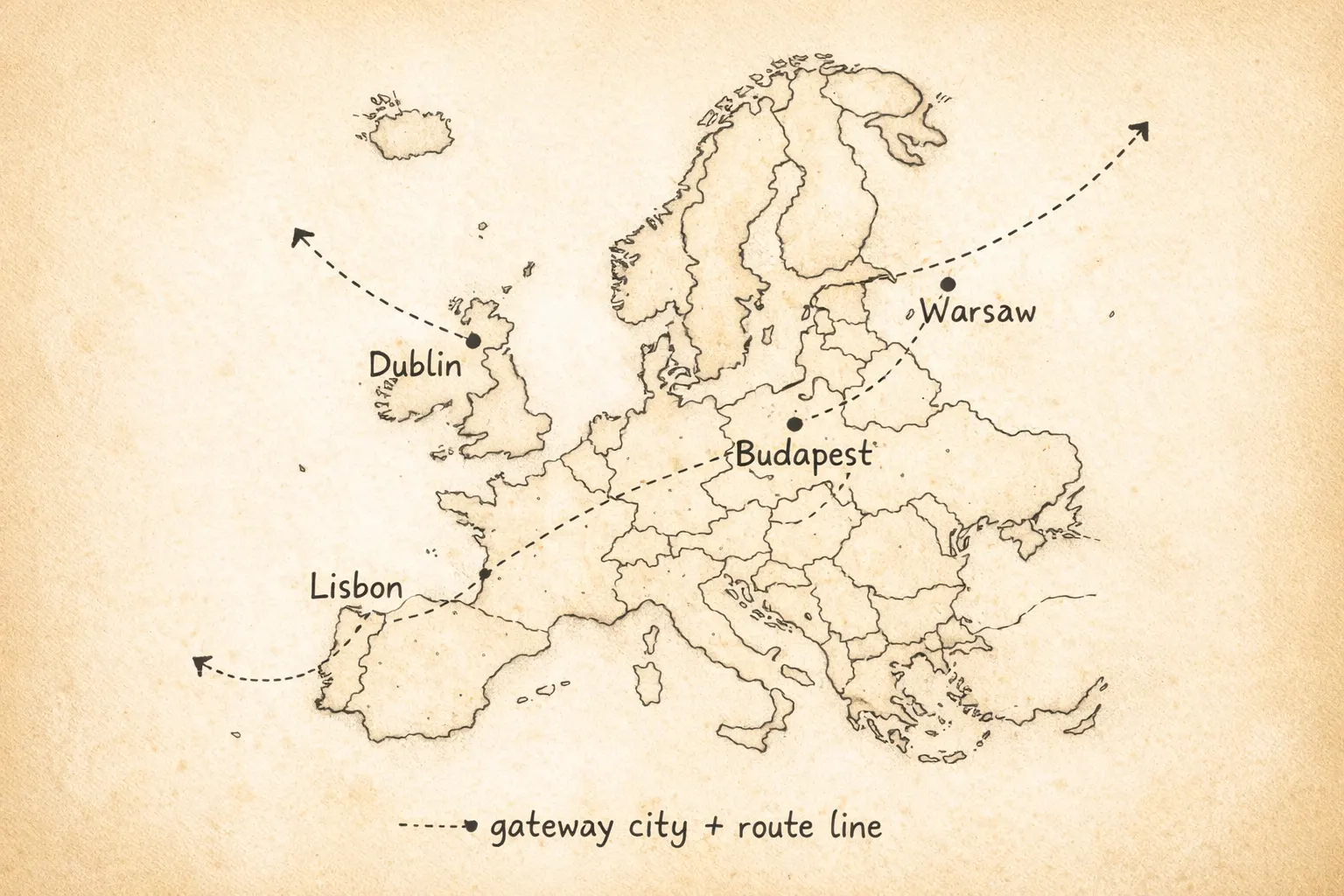
Europe Gateways Worth Knowing
Budget airlines have completely reshaped European routing. The cheap long-haul fares from North America tend to cluster around a handful of entry cities:
- Lisbon — consistently one of the cheapest transatlantic entry points, well-served by TAP and frequently discounted by US carriers.
- Dublin — US preclearance means you clear customs before you land, and Ryanair connects onward from here to almost everywhere.
- Budapest, Krakow, Warsaw — often dramatically cheaper than Western European hubs, with easy budget airline connections west.
- Barcelona, Madrid — competitive long-haul prices, and Vueling + Iberia cover the rest of Iberia cheaply.
Intra-European flights on Ryanair, Wizz Air, and easyJet frequently run €20–€60 — sometimes less. For cheap flights in Europe, a transatlantic fare to Lisbon plus a €35 hop anywhere in Western Europe often beats a direct flight by €150 or more. You just have to be willing to think in two legs instead of one.
Southeast Asia Gateways
The same logic runs in Southeast Asia, and the savings are often even bigger. A London to Bali direct flight regularly prices above £900. London to Kuala Lumpur: often £400–500. A $35 AirAsia hop from KL to Bali: total trip under £550. The three entry hubs where cheap long-haul fares cluster:
- Bangkok (BKK/DMK) — Asia’s most connected hub; AirAsia and Thai Lion cover onward routes cheaply from both Suvarnabhumi and Don Mueang.
- Kuala Lumpur (KUL) — AirAsia’s home base. Cheap flights from KL to almost anywhere in the region. Often underpriced on the long-haul leg.
- Hanoi or Ho Chi Minh City — good for long-hauls from Europe especially; VietJet and Bamboo connect the rest of Vietnam and regional neighbours.
Fly into Bangkok, take a $30 AirAsia hop to Bali. Fly into KL, take a $25 flight to Siem Reap. For cheap flights to Southeast Asia, this two-leg approach almost always beats searching direct.
The Right Tool for the Right Job: Skyscanner vs Google Flights (+ Kiwi.com)
Every article on this topic says “use all three.” That’s not useful advice. Here’s what each tool actually wins at — so you use the right one first and the others as confirmation.
| Tool | Best for | Key feature | Limitation |
|---|---|---|---|
| Skyscanner | Budget carrier discovery, SE Asia routes, flexible month view | “Everywhere” search + cheapest month calendar | Sometimes routes to OTAs with worse change policies than booking direct |
| Google Flights | Price tracking, US-origin routes, multi-city Europe itineraries | Fare calendar, price history graph, reliable price alerts | Doesn’t surface budget carriers consistently (especially in Asia) |
| Kiwi.com | Complex multi-stop routing, self-transfer itineraries, nomad tool | Combines separate airlines on one itinerary; Nomad tool for multi-city | Self-transfers mean you’re responsible if a connection misses |
Skyscanner wins for Southeast Asia because it surfaces AirAsia, Nok Air, Scoot, and the rest of the budget carriers that Google either misses or ranks poorly. If you’re routing through Asia, start here.
Google Flights wins for price tracking and European multi-city. The fare calendar and price history graph show you whether a fare is actually normal or inflated — that’s context Skyscanner doesn’t give you. Set a price alert here; it’s the most reliable one available.
Kiwi.com wins for complex routing — specifically if you’re doing a multi-country trip, want to book one-way legs on separate airlines, or don’t want to pay round-trip prices. The Nomad tool lets you input multiple destinations and finds the cheapest order and combination of legs. It also books self-transfer itineraries that official flight search tools won’t touch. The tradeoff: you’re responsible for the connection. Give yourself real buffer time on self-transfers — 3+ hours minimum, more if the airports differ.
Not sure which to open first? Answer two questions below and get a straight recommendation.
Which Flight Search Tool Should I Use?
Answer two questions and get a straight recommendation.
Where are you flying to?
How fixed are your dates?
When to Book: Regional Windows That Actually Matter
“Book 6–8 weeks out” is advice written for domestic US flights. It doesn’t transfer well to long-haul or international routing. The windows that actually matter vary by region and season.
Southeast Asia
The sweet spot for cheap flights to Southeast Asia is 6–10 weeks out for peak season travel (December–January, July–August). Low season is genuinely different — fares in the shoulder months (May–June, September–October) can be found much later, sometimes 2–3 weeks out, because airlines are filling planes that aren’t selling fast.
Last-minute cheap flights to Southeast Asia exist — but they work best when you’re flexible on both the departure date and the gateway city. If you’re locked in on “Bangkok, Saturday the 14th,” last-minute doesn’t help. If you’re open to “somewhere in Southeast Asia within a 2-week window,” it can.
Europe
For cheap flights to Europe in summer (June–August), you need more runway — 3–4 months out for transatlantic, with budget carrier intra-Europe hops often cheapest 4–6 weeks before departure. Shoulder season (April–May, September–October) is more forgiving: 6–8 weeks out tends to work well, and last-minute deals appear more often because European budget carriers discount unsold seats heavily. If you’re weighing train vs. flight for European legs, our Eurail pass cost breakdown runs that calculation in detail.
The single most reliable cheap-flight window to Europe is September–October — after peak crowds, before winter fares hit. For the full country-by-country breakdown of when each destination is cheapest and best to visit, see shoulder season travel in Europe.
Long-Haul in General
For any flight over 10 hours, pricing is driven more by demand cycles than a fixed booking window. The pattern that holds most consistently: prices are highest 0–3 weeks before departure and 4–6 months before for peak travel dates. The middle range — 6–12 weeks out for most destinations — tends to be where the reasonable fares sit. Not the lowest possible, but within range.
One side note worth filing: Expedia’s Air Hacks Report flagged Friday as the cheapest day to fly internationally on many routes, driven by reduced business travel at week’s end. Not a rule, but worth a check when your dates flex by a day or two.
The Budget Airline Math: When Cheap Stops Being Smart
This is the section every other cheap flights article skips. And it’s the one that separates a luxury backpacker from a budget tourist.
A £35 Ryanair flight from London Stansted to Rome Ciampino looks like a deal. Run the full math:
- Stansted is 90 minutes from central London by train: £18 each way.
- Ciampino is 40 minutes from Rome city centre: €6 by bus, or €40+ taxi.
- Ryanair’s “free” carry-on often isn’t — priority boarding + cabin bag fee runs £25–45 depending on route and timing.
- Departure: 6:15am, meaning a 4am alarm or an overnight in an airport hotel.
Total: £35 flight + £36 train (both ways) + £40 airport transfers (approx.) + £35 bag fee = ~£146. Versus a £90 direct easyJet flight from Heathrow to Rome Fiumicino, 30 minutes from the centre, with a sensible departure time. The “cheap” flight cost over £50 more — all in one currency.
This is the calculation luxury backpackers make before every budget airline booking:
| Variable | What to check |
|---|---|
| Airport location | How far is it from the city? What does the transfer actually cost? |
| Departure time | A 5am departure often means an extra hotel night the day before. Add that. |
| Bag fees | Ryanair, Wizz, Spirit — check the actual fare class. Add bags at booking, not at the gate. |
| Arrival city | Does it actually land near where you’re going, or do you need another connection? |
| Recovery cost | A brutal overnight connection that wrecks your first day isn’t free — it costs you a full day. |
When the total-cost calculation still favours the budget option — great, take it. When it doesn’t, the more expensive direct is the smarter flight. For a deeper look at when to take the bus instead, our cheapest way to travel Europe breakdown runs this same math for common SE Asia and Europe routes.
One more thing worth knowing before you book budget airlines in Europe: EU261 compensation is real money when flights go wrong. If your EU flight is delayed 3+ hours or cancelled, you could be owed up to €600 under EU261 regulations — Compensair handles the paperwork and claim for you, taking a percentage only if they win.
With the tools, timing, and real costs sorted, here’s how it all comes together in practice.
The 20-Minute Search Workflow
Here’s the actual search sequence, start to finish — not aspirational, just what works before booking any international flight.
- Open Google Flights first. Search your origin → destination with flexible dates (±3 days). Look at the fare calendar. Get a baseline: what does this route normally cost, and is the price you’re seeing high or normal?
- Gateway check. Before locking in, search your origin → the cheapest gateway into that region using Skyscanner’s “Everywhere” or Google’s explore map. If an entry city is $150–200 cheaper and has cheap onward hops, price the two-leg version.
- Cross-check on Skyscanner. Run the same search. Skyscanner often surfaces budget carriers that Google misses, especially for Asia routes. Use the “cheapest month” calendar if your dates are flexible.
- Complex routing? Try Kiwi.com. If you’re doing multi-city (3+ stops) or an unusual routing, run it through Kiwi’s Nomad tool. You’ll sometimes find combinations that are $200–300 cheaper than anything Google or Skyscanner shows.
- Set one alert — then stop refreshing. Pick the best fare you’ve found. Set a Google Flights price alert for that route and your target price. Check it once a day. Don’t live in the tab.
- Book when the price is within 10–15% of the lowest you’ve seen. You’ll almost never catch the exact lowest price. Waiting for it often means watching a reasonable fare disappear. If it’s within range and the total-cost math works, book it.
The goal isn’t to find the single lowest fare that ever existed. It’s to find a genuinely good fare confidently, in under 20 minutes, and move on. That’s the system.

If you’re flying within Southeast Asia or Europe, compress the timeline — intra-regional hops are often cheapest 3–5 weeks out, so don’t bother setting an alert for a €30 flight, just buy it when you see it. Once you’ve run the workflow and landed on a gateway city, the booking itself often spans more than one leg: the flight in, then a train or a hotel for the night before your onward hop.
Search Flights, Hotels, and Trains Together
If your cheap flight lands you in a gateway city rather than your final destination, Trip.com lets you price the flight, the onward train, and a night’s hotel in one search — useful for pricing the full two-leg trip, not just the first hop.
The Luxury Backpacker Flight Stack (Quick Reference)
The best flight search tools each win at something different. Here’s the cheat sheet for which to reach for first:
| Situation | Best approach | Tool to start with |
|---|---|---|
| Long-haul to Europe, flexible entry city | Gateway search → cheapest entry + budget hop | Skyscanner “Everywhere” |
| Long-haul to Southeast Asia | BKK or KUL entry + AirAsia onward | Skyscanner, then check direct |
| Multi-city trip (4+ stops) | Kiwi Nomad tool for routing | Kiwi.com |
| Fixed dates, need price history | Google Flights fare calendar + alert | Google Flights |
| Last-minute flexible travel | Skyscanner “Everywhere” next 3 weeks | Skyscanner |
| Budget airline option found | Run the full total-cost calculation first | Pen and paper |
Flight prices based on 2025–2026 searches — fares change constantly, treat these as directional.
Frequently Asked Questions
Conclusion
The person sitting next to me on that flight to Southeast Asia paid $890. I paid $487. Same plane, same seat class, same day. The difference wasn’t luck or an insider trick — it was starting the search differently. Gateway first, not destination. Right tool for the right job. Full cost math before committing. And a decision rule that meant I stopped refreshing and just booked.
That’s the whole system. It takes about 20 minutes, works on any route, and compounds every time you use it.
Flight prices, airline baggage policies, and fare rules change frequently and without notice — always verify current pricing and terms directly with the airline or booking platform before purchasing. EU261 compensation eligibility depends on the specific circumstances of your delay or cancellation and is subject to the airline’s determination of “extraordinary circumstances”; a submitted claim is not a guarantee of payout. Self-transfer itineraries (separately booked connecting flights) carry real risk of missed connections, and the airlines involved are not responsible for delays between segments booked independently of each other.