Last updated: June 2026.
I did my first Europe trip in 21 days, visited 11 cities, and came home with 2,400 photos and a two-week migraine. The problem wasn’t the cities — it was the route.
I’d built it the way most people do: open Google Maps, drop pins on every place I’d ever wanted to see, connect the dots, call it an itinerary. I moved every 1.5 days on average. I took a 5am Ryanair out of Beauvais to save €22. I arrived in Prague so tired I spent the first afternoon lying on the bed watching the ceiling. I technically “saw” Central Europe. I felt almost none of it.
What most europe backpacking route guides skip: the problem isn’t which cities you pick — it’s how you connect them, and whether that connection leaves you energized or eroded by the time you arrive. This is a framework for building the second kind of route.
This guide covers a five-principle routing framework, complete 2-week and 3-week sample itineraries with real transit times and costs, and a transit decision guide you can apply to any route you build. It’s all organized around comfort first — because cost follows naturally from a route that actually works.
For more on the tactics that make the difference between a trip that drains you and one that doesn’t, this post is part of the full backpacking hacks guide system.
This post contains affiliate links, including Amazon links. As an Amazon Associate, I earn from qualifying purchases at no extra cost to you. Learn more.
Table of Contents
- The Real Cost of a Bad Europe Backpacking Route
- Five Principles for Planning Your Europe Backpacking Route
- How to Plan a Backpacking Trip Through Europe: Step-by-Step
- Sample 2-Week Europe Itinerary
- Sample 3-Week Europe Itinerary
- Transit Decision Guide: Train vs Flight vs Bus
- The Comfort Upgrade Ladder
- Route Comfort Checker
- Underrated European Cities Worth Building Into Your Route
- Frequently Asked Questions
If you already have a draft route in mind, run it through the checker below first — it’ll flag the specific comfort gaps while the framework that follows is still fresh.
Route Comfort Checker
Answer 7 questions about your draft itinerary to get a comfort score.
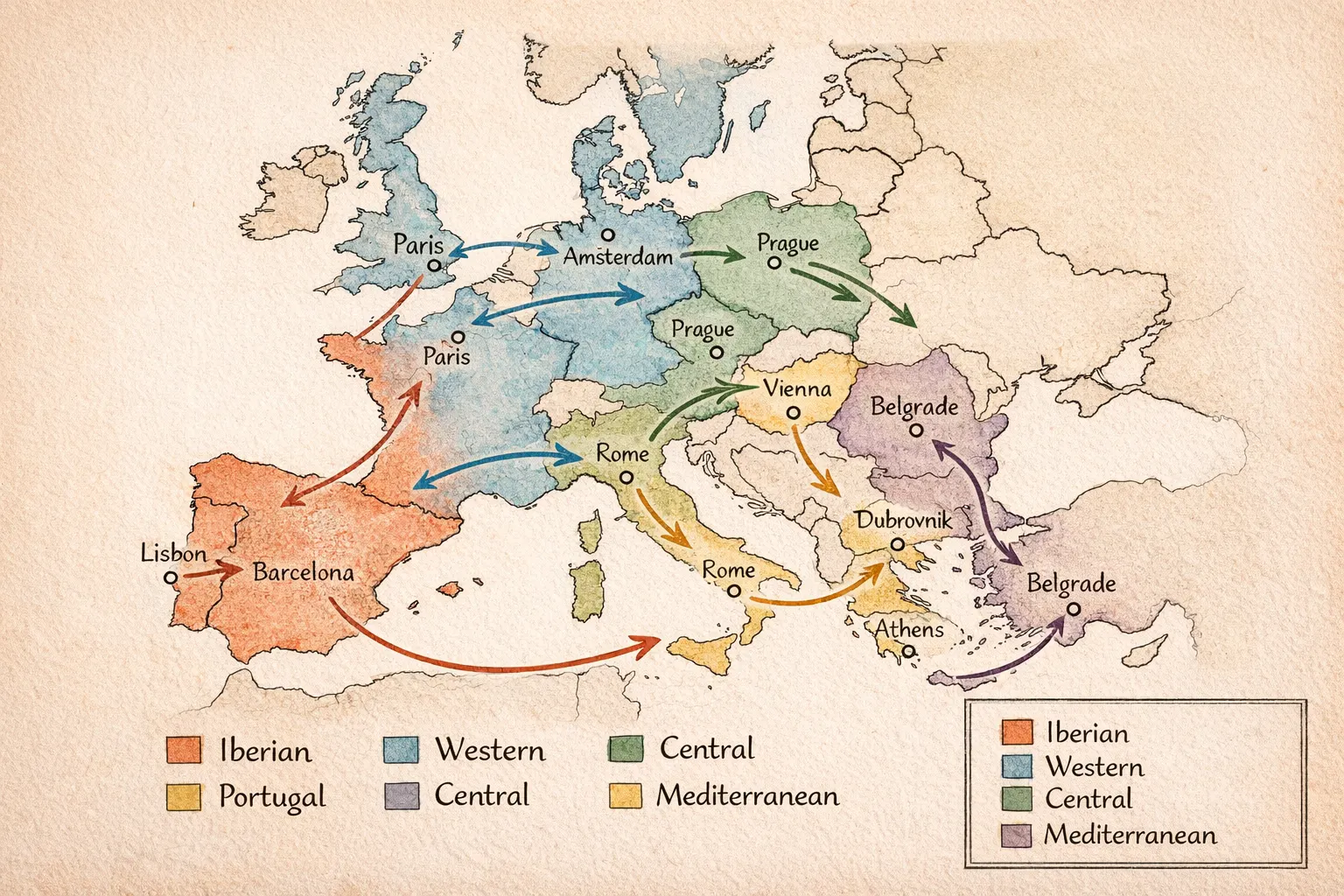
The map below shows how Europe’s main backpacking regions group into natural routing clusters — the structural foundation for everything in this guide.
The Real Cost of a Bad Europe Backpacking Route
Most articles on any europe backpacking route treat routing as a cost optimization problem. What’s the cheapest way to get from A to B? Which cities can you hit in 14 days? The answer, implicitly, is always: more cities, cheaper transport, maximum coverage.
But there’s a cost those articles never calculate: the experience cost of bad routing.
It looks like this. You book a 6am bus from Barcelona to Valencia because it saves €18 over the afternoon train. You arrive at 10:30am, groggy, dragging your bag through a neighborhood you don’t recognize yet. Check-in isn’t until 3pm. You’re in one of Spain’s most beautiful cities and you can’t think straight. You waste the morning in a café not really seeing anything. By the time you feel human again, it’s evening. You have 36 hours left.
Bad routing doesn’t just cost money — it costs the actual quality of your trip. And unlike overspending, you can’t recover it. The days are gone.
The comfort-first approach inverts the logic: design the route for how you’ll feel at each arrival, then optimize cost within that constraint. Usually the gap between the comfort option and the budget option is €15–30 per leg. Over a 3-week trip with 6 transit moves, that’s €90–180 total. That’s the price of arriving ready to explore instead of ready to collapse.
Five Principles for Planning Your Europe Backpacking Route
Every chronic complaint backpackers come home with — always tired, wishing they’d stayed longer, arriving before they’ve recovered from the last move — traces back to one of these five decisions.
1. Cluster by geography, not by wish list
The classic planning mistake: you list every city you want to see, then try to connect them into a route. The result is usually geographic chaos — Western Europe to Central Europe back to Southern Europe, zigzagging across the continent because your wish list didn’t respect geography.
Europe breaks into natural routing clusters. Within a cluster, transit is easy, cheap, and often under 3 hours. Between clusters, you’re committing to a 5–8 hour journey that should be planned deliberately, not stumbled into.
The main clusters for most backpacker routes:
- Iberian: Lisbon, Porto, Seville, Madrid, Granada, Barcelona
- Western: Paris, Amsterdam, Brussels, London (if you include it)
- Central: Prague, Vienna, Budapest, Kraków, Berlin
- Mediterranean/South: Rome, Florence, Naples, Dubrovnik, Split
- Balkans: Ljubljana, Zagreb, Sarajevo, Kotor
A well-structured route moves through 2 clusters maximum on a 2-week trip, 3 clusters on a 3-week trip. Trying to hit all five in two weeks is how you end up with the migraine.
2. The 3-night minimum rule
One night in a city is a layover. Two nights means you’ve barely oriented yourself before you’re packing again. Three nights is the minimum to actually live somewhere, even briefly — one day to find your feet, one day to explore properly, one morning to revisit your favorite street before you leave.
Major cities (Rome, Paris, Barcelona, Prague) need 4–5 nights to feel unhurried. Mid-size cities (Porto, Ljubljana, Ghent) work at 3. Small stops and transit hubs can be 2. One-night stays should be genuinely rare — reserve them for last-minute detours or places you’ve been before.
3. Treat transit days as transit days
A transit day is not a sightseeing day. If you’re moving between cities, the arrival city deserves a gentle evening — find your accommodation (see what is a boutique hotel for how to pick the right stay type), eat somewhere nearby, sleep. The next morning you explore.
The mistake is planning arrival day as sightseeing day and then wondering why you always feel behind. You’re not behind — you’re just not accounting for the energy cost of moving.
4. Choose entry and exit cities for convenience, not prestige
Open-jaw flights — flying into one city and out of another — are often cheaper than returning to your starting point, and they remove the backtracking that kills comfort. Flying into Lisbon and out of Budapest is a coherent westward route through two clusters. Flying into London and out of London for a 3-week Central Europe trip means either an expensive deadhead leg or a wasted day getting back.
Check open-jaw prices before you set your route in stone. The best entry city is the one that positions you for a logical forward-moving journey.
5. Build in at least one recovery city
Every good multi-week route has one city that’s genuinely slow — a place with no must-see monuments, where you’re allowed to sleep past 8am, sit in a square, eat lunch for two hours, and not feel like you’re wasting the trip. Porto, Ljubljana, Ghent, Bologna, Plovdiv — these are recovery cities. They also tend to be cheaper, less crowded, and more memorable than the headline destinations.
Plan it deliberately. Put it after your most intense cluster. Don’t feel guilty — it’s what makes the rest of the trip feel good.
How to Plan a Backpacking Trip Through Europe: Step-by-Step
Here’s the step-by-step process for how to plan a backpacking trip in Europe around comfort rather than cost — and produce a europe travel itinerary that doesn’t fall apart the moment you check into your second city.
- Fix your trip length and identify your non-negotiables. Write down the 3–5 cities you’d genuinely be disappointed to miss. That’s your core. Everything else is flexible.
- Map your non-negotiables to clusters. Which of the 5 clusters above do your must-see cities belong to? If they span 3+ clusters on a 2-week trip, something has to go. Be honest with yourself now.
- Choose 2 clusters (2 weeks) or 3 clusters (3 weeks). Pick the clusters that contain your non-negotiables. Fill remaining cities from within those clusters — this is where underrated alternatives become genuinely useful.
- Allocate nights by city type. Major cities: 4–5 nights. Mid-size: 3 nights. Small/transit stops: 2 nights. Total should be trip length minus 1 (your arrival day is a soft landing, not sightseeing).
- Identify your biggest transit legs and plan them deliberately. For any journey over 4 hours, decide now: overnight (saves a hotel night, arrives early and disheveled), morning train (comfortable, arrives mid-day, costs an accommodation night), or short flight (often cheaper door-to-door than you’d expect once you factor airport time).
- Add your recovery city. Find a place between your two most intense clusters — somewhere slower, cheaper, off the main circuit. This is usually your most memorable stop in retrospect.
Sample 2-Week Europe Itinerary (Comfort-Optimized)
This 2-week europe itinerary uses open-jaw flights (into Lisbon, out of Paris) and keeps every city transition manageable. Think of it as a template — the logic for each stop is below, not just the destination.
| City | Nights | Transit in | Door-to-door | Est. transport cost | Notes |
|---|---|---|---|---|---|
| Lisbon | 4 | Fly in | — | — | Arrival city. Alfama or Príncipe Real. Slow first day. |
| Porto | 3 | Train | 3h | €15–22 | Recovery city. Ribeira district. No agenda needed. |
| San Sebastián (underrated swap) | 2 | Bus or train via Bilbao | 5–6h | €25–40 | World-class food, small city, easy to navigate. Directly en route. |
| Barcelona | 3 | Train | 5h15m | €30–55 | Eixample or Gràcia. Book Sagrada Família before you arrive. |
| Paris | 3 | TGV train | 6h30m | €40–80 | Exit city. Le Marais or Canal Saint-Martin. Fly home. |
Total nights: 15 (14 nights + 1 travel day buffer). Clusters covered: Iberian + edge of Western. Timing matters here too — shoulder season travel in Europe cuts 30–40% off these exact cities. San Sebastián is a strategic swap for Madrid — half the crowds, better food per euro, and directly en route rather than a detour. If you’re running this route in May or September (shoulder season), accommodation costs across Iberia drop noticeably and crowds are a fraction of peak July–August levels.
Sample 3-Week Europe Itinerary (Three Clusters, Not Just the 2-Week Expanded)
Adding a week to your europe travel itinerary doesn’t mean adding more cities to the same route — it means adding a third cluster. This 3 week europe itinerary runs Iberian → Western → Central. Open-jaw: fly into Lisbon, out of Vienna or Budapest.
| City | Nights | Transit in | Door-to-door | Est. transport cost | Notes |
|---|---|---|---|---|---|
| Lisbon | 3 | Fly in | — | — | Arrival. Bairro Alto area. Soft landing. |
| Seville | 3 | Bus | 2h30m | €18–28 | One of Europe’s most underrated major cities. Triana neighborhood. |
| Barcelona | 4 | Train or fly | 5–6h / 1h30m fly | €30–60 / €25–50 | Fly if you’re tired; train if you have the energy. Eixample. |
| Paris | 4 | TGV train | 6h30m | €40–80 | Le Marais. Built-in recovery half-day — Paris deserves a slow afternoon. |
| Ghent (underrated swap) | 2 | Train | 2h via Brussels | €30–45 | Recovery city. Quieter and cheaper than Brussels or Amsterdam. Medieval center is walkable and stunning. |
| Berlin | 3 | Train or bus | 4h train / 6h bus | €35–60 / €15–25 | Mitte or Prenzlauer Berg. Bus is fine here — it’s a straight run and Berlin rewards a slow morning arrival. |
| Prague | 3 | Train or bus | 4h | €20–40 | Vinohrady or Žižkov over Old Town — cheaper, quieter, better cafés. |
| Vienna (exit) | 3 | Train | 4h | €15–35 | Exit city. Fly home from Vienna Airport. |
Total nights: 25 (21 nights + transit buffer days). Clusters covered: Iberian, Western, Central. The route moves continuously eastward — every transit is forward, nothing doubles back. Ghent is the deliberate slow point between Paris and the more intense Central European cities. Vienna and Budapest both work as exit cities — Vienna is slightly more expensive but easier to fly from; Budapest is a better final city if you want to end on a high-energy note.
Transit Decision Guide: Train vs Flight vs Bus
The right transit option isn’t always the cheapest one. Whether you’re building your first europe backpacking route or refining one you’ve tried before, here’s the framework — not a set of rules, but a decision structure.
| Journey type | Best option | When to switch |
|---|---|---|
| Under 3 hours by train | Always train | Never. Flights don’t make sense here when you factor airport time. |
| 3–5 hours by train | Train, usually | Switch to flight only if the price gap is >€40 AND you’re not already fatigued. |
| 5–8 hours | Morning train or flight | If the flight is under €40 all-in (including bags), the time saving usually wins. Avoid buses on this leg unless it’s a genuine overnight sleeper. |
| Overnight (6–10h) | Overnight train or bus | Only worthwhile if you can actually sleep. Standard overnight bus seat = arriving wrecked. Pay for the sleeper berth or take a morning transit instead. |
| Over 8 hours by train | Fly | Almost always. A €35 flight beats a €60 nine-hour train ride on every comfort metric. |
The door-to-door rule: before booking any flight, add 1h30m to the journey time for each end that uses a secondary airport (Beauvais, Stansted, Bergamo, Girona). Most of the time, a €19 Ryanair stops making financial sense once you do this math. For buses, FlixBus connects most major European cities from around €10–25 and is fine for short legs under 3 hours — in my experience, anything longer than that in a standard seat starts to cost you the next morning. For checking train options across Europe, Eurail’s trip planner is the most comprehensive free tool available.
The Comfort Upgrade Ladder: Where to Spend More
Not every spend on a backpacking trip has equal return. These are the upgrades that consistently make the biggest difference — in rough order of impact.
Sleep
Private room over dorm for most trips once you’ve done a stretch of dorm life — the quality-of-sleep difference compounds fast on a two-week route. The gap in most European cities is €15–30 a night — on a 21-night trip staying private half the nights, that’s €160–320 extra total. It’s consistently the best money you’ll spend on any trip.
Transit timing
Morning or afternoon transit over early morning or overnight whenever possible. The €15–25 premium for a civilized departure time pays for itself before you even arrive.
One meal per city
Not every meal — one real one, at a place the locals eat, doing the thing the city is known for. Pintxos in San Sebastián, a proper pasteis de nata in Lisbon, Vietnamese in Paris. Budget €20–35 for it and don’t compromise. I’ve never once looked back on spending €28 on a proper meal. I’ve regretted plenty of €8 sandwiches eaten standing up because I was trying to save money at the wrong moment.
Accommodation location
Central enough that you can walk home at midnight. The €10/night saving from staying 4km out is negated by the taxi you’ll eventually take.
One anchoring experience per city
Not a full-day tour — one thing that gives you context. A two-hour walking tour on arrival day is one of the highest-return spends in travel. GetYourGuide has solid options in most cities on both routes above.
One comfort upgrade that’s easy to overlook isn’t where you sleep — it’s how much you’re carrying on city days. A packable daypack keeps your main bag checked in at the hotel and your back free from the moment you arrive. This is the one I’ve used across three different routes and never thought twice about:
OSPREY ULTRALIGHT STUFF PACK 18L — the one I actually pack
Folds down to fist-sized when empty, so it costs you zero space until the moment you need it. At 150g you forget it’s even in your bag.
Underrated European Cities Worth Building Into Your Route
These aren’t hidden gems in the Instagram sense — they’re cities that are genuinely useful to a comfort-first route because they’re less crowded, easier to navigate, and often better value than the headline alternatives nearby.
- Porto (Iberian cluster): Better than Lisbon as a second stop — smaller, hillier, slower. Excellent for a recovery day after 4 nights in the capital.
- San Sebastián (Iberian/Western border): One of the best food cities in the world, half the crowds of Barcelona, and directly en route if you’re moving toward France. 2 nights is enough.
- Ghent (Western cluster): Quieter, cheaper, and architecturally more intact than Amsterdam or Brussels. Works perfectly as a 2-night recovery stop between Paris and Germany.
- Plovdiv (Balkans): If you’re doing a Central/Balkan route, Plovdiv over Sofia. More intact Ottoman and Revival architecture than anywhere else in Bulgaria, tourism is still genuinely low-key, and it’s a 2-hour bus from Sofia airport.
- Bologna (Mediterranean): If you’re doing Italy — Bologna over Venice for your second city. Better food, no flood-prone piazzas, easier to navigate, and one of the best university towns on the continent.
None of these replace the headline cities. They complement them — and they’re usually where the trip gets interesting.
Prices based on 2025–2026 data.
Frequently Asked Questions
The Route Is the Foundation
Everything else on a backpacking trip — the accommodation, the food, the experiences — builds on the route. Get the route wrong and no amount of upgrading your sleep or splurging on a good meal fixes the structural problem: you’re always moving too fast, arriving too tired, leaving before you’ve settled in.
Get your europe backpacking route right and the whole trip changes. You start arriving somewhere and feeling like you’re visiting, not just passing through. You have a morning in Porto where you know where the coffee is. You spend three days in Prague and actually have a favorite bar by the end. You come home not just having seen Europe, but having felt it.
Use the routes above as a starting template and adapt city order to your entry point. For the specific upgrade decisions within each stop — boutique hotel vs private hostel room vs villa split — the accommodation comparison above covers that breakdown, and the Europe backpacking itinerary maps the city-by-city version of this same route in full detail.
You’ve now got the framework — five principles, two sample routes, the transit logic to adapt either one. The harder part is keeping every cluster, night count, and transit leg straight once you’re actually building your own version of it. That’s where the toolkit picks up.
Explore the Luxury Backpackers ToolkitIt’s free, and built to be used alongside whichever route you end up booking.
One last thing before you start booking: transit prices, train schedules, and seasonal availability change — confirm current times and fares directly with the carrier before locking in any leg of your route.