Last updated: June 2026.
The flight wasn’t bad. The bus wasn’t bad. The hostel wasn’t bad. But three weeks in, you were exhausted — and you couldn’t explain why.
That’s how friction works. No single thing breaks you — it’s the cumulative tax. Two nights of thin sleep. A dead phone with no outlet in sight. Six hours on a train with headphones that don’t actually cancel noise. An adapter that needs coaxing before it grips the wall socket. These things are small, but they compound — and they’re all small on their own. Individually, annoying. Together, they drain the whole trip. This is the best travel accessories list built specifically to fix that.
Most lists throw 35 travel must haves at you and call it a day. This one doesn’t. Eight categories, one or two specific picks per category — all filtered against the cumulative friction test. Every item earns its weight, gets an honest trade-off, and a clear “skip this if” — not just a buy button. If you’re already comfortable with one-bag travel and have done at least one trip where something small drove you quietly insane, this is for you.
Start with the luxury backpacking system if you’re newer to this style — this post picks up where the gear framework leaves off.
Some links on this page are Amazon affiliate links. As an Amazon Associate, I earn from qualifying purchases at no extra cost to you. I only recommend gear I’d actually use. Prices listed are USD; check your local Amazon for regional pricing.
Table of Contents
- Find Your Friction: What to Buy First
- Sleep Infrastructure
- Charging Ecosystem
- Noise and Focus
- Power Compatibility
- The One Underrated Pick
- Frequently Asked Questions
- Where to Start
Find Your Friction: What to Buy First
Pick your biggest friction point — get your highest-impact category.
What’s your biggest problem on long trips?
Most people don’t need all eight categories. Start with one — fix your biggest friction point first. That single upgrade usually changes how the entire trip feels. The rest of this article gives you specific picks, honest trade-offs, and a clear reason to skip each one if it doesn’t apply to you.
Sleep Infrastructure
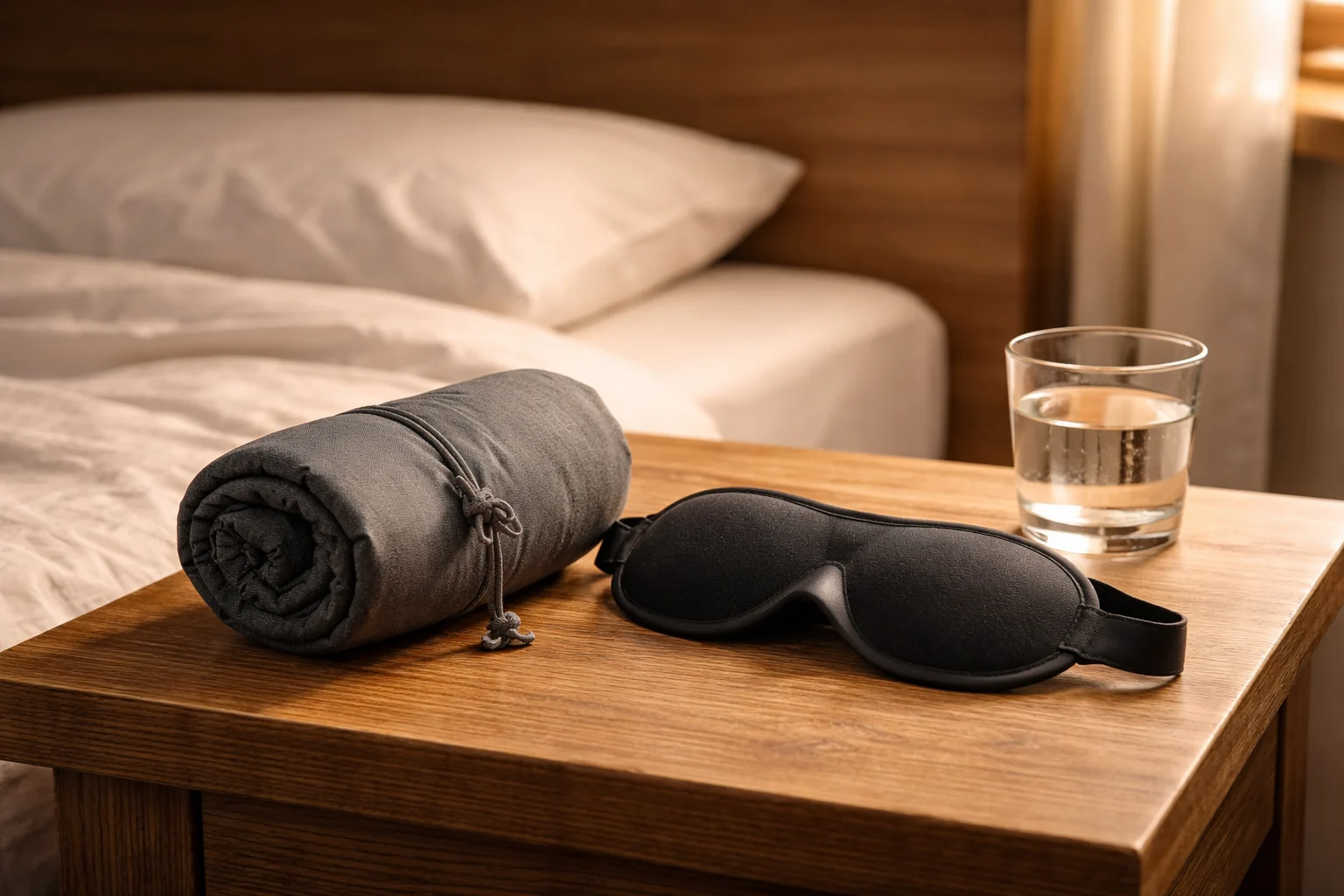
Sleep is the highest-leverage category on this list — and the most underinvested. I’ve tracked this across a dozen long trips: every time I skimped on sleep gear, I paid for it by day five. One bad night in a noisy hostel is manageable. Two weeks of mediocre sleep turns a good trip into a survival exercise. Most people skip the upgrade because it feels indulgent. It isn’t — it’s operational.
Travel Pillow
Choosing the best travel pillow comes down to how you actually sleep in transit. Inflatable pillows pack small but feel like a balloon against your neck. Cheap memory foam compresses to nothing after a few trips. Two options are worth your money:
Trtl Pillow Plus — Not technically a pillow. It wraps around your neck with an internal spine that holds your head upright. Looks strange. Works well on planes and long bus rides where your head would otherwise fall sideways. It’s not comfortable for back-sleepers on flat surfaces, but for transit it’s the best option under $60. Packs flat. Washable. Some people find the pressure too firm — try it before a long-haul.
Cabeau Evolution S3 — Proper memory foam with a velcro strap that clips to your headrest so it doesn’t slide forward while you sleep. Heavier than the Trtl and takes up more bag space. Worth it if you’re doing multiple overnight flights or have neck issues. The S3 version fixed the old rotation problem with an improved clip system.
If transit sleep is your biggest gap, this is the pick to start with:
Transit sleep, best pick:
Trtl Pillow Plus — Compact travel pillow, best for planes and buses.
Sleep Mask
This is the accessory most people skip and most regret skipping. A quality sleep mask is not a luxury item — it’s the difference between sleeping until 9am in a hostel dorm and waking at 6:30am because someone opened the curtains.
What people get wrong: they buy a flat foam mask that presses against their eyelids, which is uncomfortable and lets light in at the edges. What you want is a contoured mask — one with moulded cups that sit around the eye socket, not on the eyeball.
MZOO Sleep Eye Mask — Contoured, blocks light well, adjustable strap that doesn’t tangle hair. Under $15. There’s almost no reason to spend more unless you want a weighted or cooling-gel version. I’ve had mine through two years and it’s still fine.
Alaska Bear Natural Silk Sleep Mask — Flat, not contoured, but the silk is genuinely soft and doesn’t irritate skin or tangle hair. Better for people who find the contoured style claustrophobic. Slightly less effective at full blackout, but good for lighter sleepers who just need edge-dimming.
Dorm blackout, under $15:
MZOO Sleep Eye Mask — Contoured, full blackout.
Earplugs
Earplugs are table stakes, not an upgrade — but people consistently buy the wrong kind. Foam disposables have NRR ratings around 32–33dB, which handles most snoring. For a 10-bed dorm during a festival weekend, they’re not enough — that’s what headphones are for. Loop Quiet reusable silicone plugs (NRR 26dB, ~$25) are far more comfortable for sleeping because there’s no expansion pressure. They come with four tip sizes and actually fit without hurting at 3am.
| Item | Weight | Price (approx) | Best for | Honest trade-off |
|---|---|---|---|---|
| Trtl Pillow Plus | 148g | $50 | Transit sleep, planes, buses | Useless for flat sleeping; looks odd |
| Cabeau Evolution S3 | 280g | $50 | Long-haul flights, neck issues | Bulkier; takes real bag space |
| MZOO Sleep Mask | 35g | $15 | Dorm blackout, any light situation | Contoured style bothers some people |
| Loop Quiet | 22g | $25 | Sleeping, moderate noise | Lower NRR than foam — not for loud environments |
Charging Ecosystem
This is where most people underspend and pay for it on the road. These days, almost every quality laptop, phone, and earbud charges via USB-C — which means one coherent ecosystem can replace the tangle of different cables and bricks most people travel with. Before sorting accessories, make sure your full backpacking packing list has the essentials covered. The failure mode isn’t dramatic — it’s slow. A charger doing 18W when your laptop needs 65W. A power bank topping off at 10W when your phone supports 30W. You’re never fully dead, but you’re never fully charged either. Over three weeks, it grinds you down.
The goal is simple: one charger that handles everything, one power bank that’s actually fast, and one adapter that doesn’t fail in a 220V wall.
GaN Charger
GaN (gallium nitride) chargers run cooler and smaller than traditional chargers at the same wattage. There’s no reason to travel with anything else. The key spec is wattage — specifically whether the charger delivers its rated wattage to a single port when you need it.
Anker 65W GaN Charger (3-Port) — Two USB-C ports and one USB-A. Charges a MacBook at full speed on port 1 (65W solo), drops to 45W on port 1 and 20W on port 2 when both are in use. Around $46, and in my experience these hold up well — I’ve run mine through 18 months of trips without issue. For most one-bag travelers with a laptop, phone, and earbuds, this is the right buy.
Anker 511 Nano III (30W) — Single USB-C port, roughly the size of an Apple USB-C brick. Not enough for a laptop at full speed, but fine for phones, earbuds, and tablets. If you don’t travel with a laptop, this is all you need.
If you’re charging a laptop on the road, this covers everything from one outlet:
One charger for everything:
Anker 65W GaN Charger (3-Port) — Handles laptop, phone, and earbuds from one brick.
Power Bank
The mistake people make: buying based on mAh (capacity) and ignoring output wattage. A 20,000mAh bank charging at 10W is slower than a 10,000mAh bank at 30W. For a phone that takes 1.5 hours at 30W, the slow bank takes 4+ hours. On a full travel day — the kind where you’re moving between cities and your only charging window is a 45-minute café stop — that difference means arriving somewhere with 30% battery instead of 90%.
Anker 733 Power Bank (GaNPrime 65W) — A hybrid unit: functions as both a wall charger and a 10,000mAh power bank. Plug it in to charge itself and your devices simultaneously. Around $70. The limitation: 10,000mAh covers about two full phone charges. If you’re off-grid for multiple days, you need a larger standalone bank.
Anker 747 Power Bank (26,800mAh) — Serious capacity, 87W output, charges a laptop via USB-C, weighs 668g. Too heavy for ultralight setups, but legitimate for multi-device travelers doing long transit days.
Here’s how the four options compare, so you can build the right stack rather than buying pieces that undercut each other:
| Item | Weight | Output (max) | Best for | Honest trade-off |
|---|---|---|---|---|
| Anker 65W GaN Charger (3-Port) | 100g | 65W single port | Laptop + phone daily charging | Drops to 45W when both ports active |
| Anker 511 Nano III (30W) | 52g | 30W | Phone/tablet-only travelers | Too slow for most laptops |
| Anker 733 Hybrid Bank | 240g | 65W | One carry-on-friendly combo unit | Only 10,000mAh capacity |
| Anker 747 Large Bank | 668g | 87W | Multi-device, long off-grid days | Heavy — not for ultralight setups |
Noise and Focus
The right noise cancelling headphones travel with you on every long transit day — and their absence compounds just as much as bad sleep. Most people already want a good pair and delay buying because of the price. I delayed for two trips and spent both of them managing fatigue I could have avoided. That delay usually costs more than the headphones.
Noise Cancelling Headphones
The honest split: there are $50–80 options that do decent ANC, and $250–350 options like the Sony WH-1000XM5 that do genuinely excellent ANC. For most people who aren’t audiophiles and aren’t on planes twice a week, the mid-tier is fine. For frequent long-haul travelers, the premium tier pays for itself in recovered sleep.
Soundcore Space Q45 — Multi-mode adaptive ANC that automatically adjusts to your environment — plane, café, commute. 50-hour battery with ANC on, LDAC support for hi-res audio, Bluetooth 5.3. Blocks most engine hum and ambient noise well. Doesn’t handle sudden loud noises (announcements, door slams) as cleanly as the premium tier. For bus, train, and hostel use, this is the value pick.
Sony WH-1000XM5 — Around $280. Industry-leading ANC that makes a 13-hour flight noticeably quieter. Outstanding call quality. They don’t fold flat (unlike the XM4) — a real trade-off for bag space. Worth it if you travel long-haul regularly or work in noisy environments abroad.
The decision framework: if you fly long-haul more than twice a year or regularly work from cafés, the premium tier pays for itself faster than it looks. If your travel is mostly buses, trains, and hostels, the mid-tier delivers 80–90% of the benefit at half the cost.
For everyone else — regional flights, overnight trains, hostel common rooms — the value pick handles all of it:
Long-haul value pick:
Soundcore Space Q45 — Adaptive ANC, 50-hour battery, ~$150. The value case for most one-bag travelers.
Power Compatibility
A travel adapter is the accessory people buy wrong more consistently than any other. The cheap universal adapters — the white plastic ones that cost $10 — work until they don’t. The failure mode is usually a loose fit (your plug slowly droops out of the socket), overheating, or no surge protection. In countries with unstable voltage — parts of Southeast Asia, older buildings in Eastern Europe — no surge protection means a real risk to your laptop or phone.
What to look for: global coverage (UK, EU, US, AU), USB-C passthrough at 30W or more, surge protection, and a build where the plugs click in and stay.
Ceptics World Travel Adapter Kit — Around $30. Covers 150+ countries, USB-A ports plus USB-C PD at 45W — which is actually useful for charging a laptop at reasonable speed, not just phones. Built-in surge protection fuse, and the plug heads click firmly into place without wobbling. The 45W USB-C output is what separates this from cheaper adapters stuck at 15W — worth paying for if you’re doing any real charging through the adapter itself.
Zendure PassPort Pro — Around $55. USB-C PD at 30W, built-in surge protection, more compact for what it offers. If you want to run your laptop through the adapter itself, the 30W output matters. Still not a replacement for a dedicated 65W GaN charger on heavy days. Pick this over the Ceptics if compact size matters more than port count.
The Ceptics meets both requirements — rated surge protection and 45W USB-C for real laptop charging:
Surge-protected, 150 countries:
Ceptics World Travel Adapter Kit — 150+ countries, 45W USB-C PD, built-in surge protection.
The One Underrated Pick
Most articles pad this section with a bonus dump. This isn’t that. One category gets skipped on almost every packing list, shows up consistently in post-trip regret conversations, and costs almost nothing relative to the problem it solves.
USB-C Cable Set — Short and Long
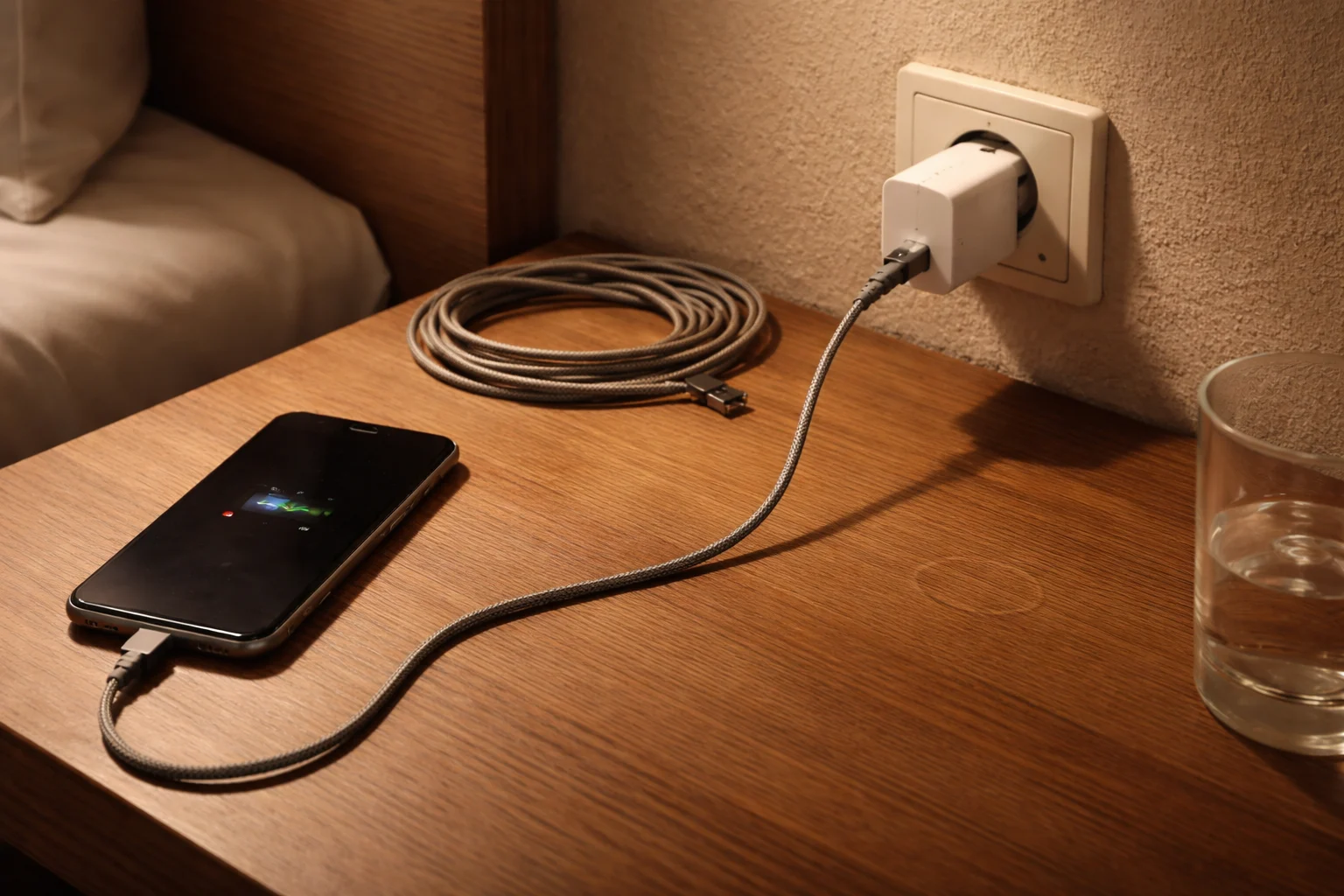
You probably have cables. You probably don’t have the right cables for travel. The problem: most people travel with one long cable and discover the outlet is above the bed, across the room, or only reachable from an awkward angle. A short cable (30cm) for charging on a desk or nightstand. A long cable (1.8–2m) for charging from a bottom bunk outlet while your phone sits on the mattress above. Both in braided nylon so they don’t tangle and actually survive a full year of travel.
Anker USB-C Braided Cable Set — Around $10–16 per cable. Get one 0.3m and one 1.8m. Make sure they’re rated for the wattage of your charger — look for “100W” on the listing if you have a 65W charger. This gives headroom and ensures compatibility with everything.
This is the accessory people laugh at until the third night they’re lying in a weird position because their cable is 30cm too short to reach the outlet from the pillow.
Two cables, every scenario:
Anker USB-C Braided Cable Set — One short (30cm), one long (1.8m), both nylon-braided and 100W-rated.
Prices correct as of 2025–2026 — check current pricing before buying.
Frequently Asked Questions
Best Travel Accessories: Where to Start
These eight best travel accessories aren’t random upgrades — they’re infrastructure. Sleep mask and pillow means consistently better rest regardless of where you sleep. GaN charger, fast power bank, and good adapter means you’re never hunting for outlets or managing battery anxiety. Noise cancelling headphones means transit time recovered instead of endured. Short and long cables means no more awkward charging gymnastics at 11pm.
If you’re starting from scratch, build the sleep and charging stack first. Those two categories account for more cumulative trip friction than everything else combined. Get those right and the rest of the trip gets easier almost automatically.
That’s the cumulative tax working in reverse. Each upgrade removes one layer. Three weeks in, you won’t be able to explain why the trip felt so different — and that’s exactly the point.
For what to carry all of this in, the best carry-on backpack guide covers the container the whole system lives in. For how to build the full kit around these accessories, see the backpacking packing list.
Some links on this page are Amazon affiliate links and earn a small commission at no extra cost to you. Recommendations are based on real-world travel use — gear earns its place or it’s not on this list.