Last updated: June 2026.
Five weeks into a Europe trip, somewhere between Barcelona and Valencia on a night Flixbus, I went through my bag and counted. Three shirts I’d bought in emergencies. One because my “travel-optimized” white linen had turned translucent with sweat and hand-washing by day 12. One because my “versatile” all-black merino pilled badly on the armholes after too many cobblestone days with a pack. One because I’d packed an all-neutral capsule that technically mixed and matched but produced exactly four distinct-looking outfits, and by week three I was tired of looking like the same person in every photo.
I’d packed 17 items. I’d bought 3 more. My 42L Osprey was overstuffed. And I still felt like I had nothing to wear for dinner in San Sebastián.
That trip broke my old system. After I got home I rebuilt it around one rule: a capsule wardrobe travel system isn’t a fashion project — it’s a travel efficiency system. The goal is 25+ visually distinct looks from 15 items, total clothing weight under 2.5 kg, and 4 weeks of sink-washing without anything looking tired. This is that system. It fits in a 40–45L carry-on, and it’s part of the broader luxury backpacking system this site is built around. The packing module in the toolkit has the checklist version if you want to work through it step by step.
This post contains Amazon affiliate links. As an Amazon Associate, I earn from qualifying purchases at no extra cost to you — I only mention things I’ve actually used on trips.
Table of Contents
- Why Most Travel Capsules Fall Apart by Week 2
- The Palette Formula That Actually Generates Looks
- The Fabric Rules That Actually Hold Up
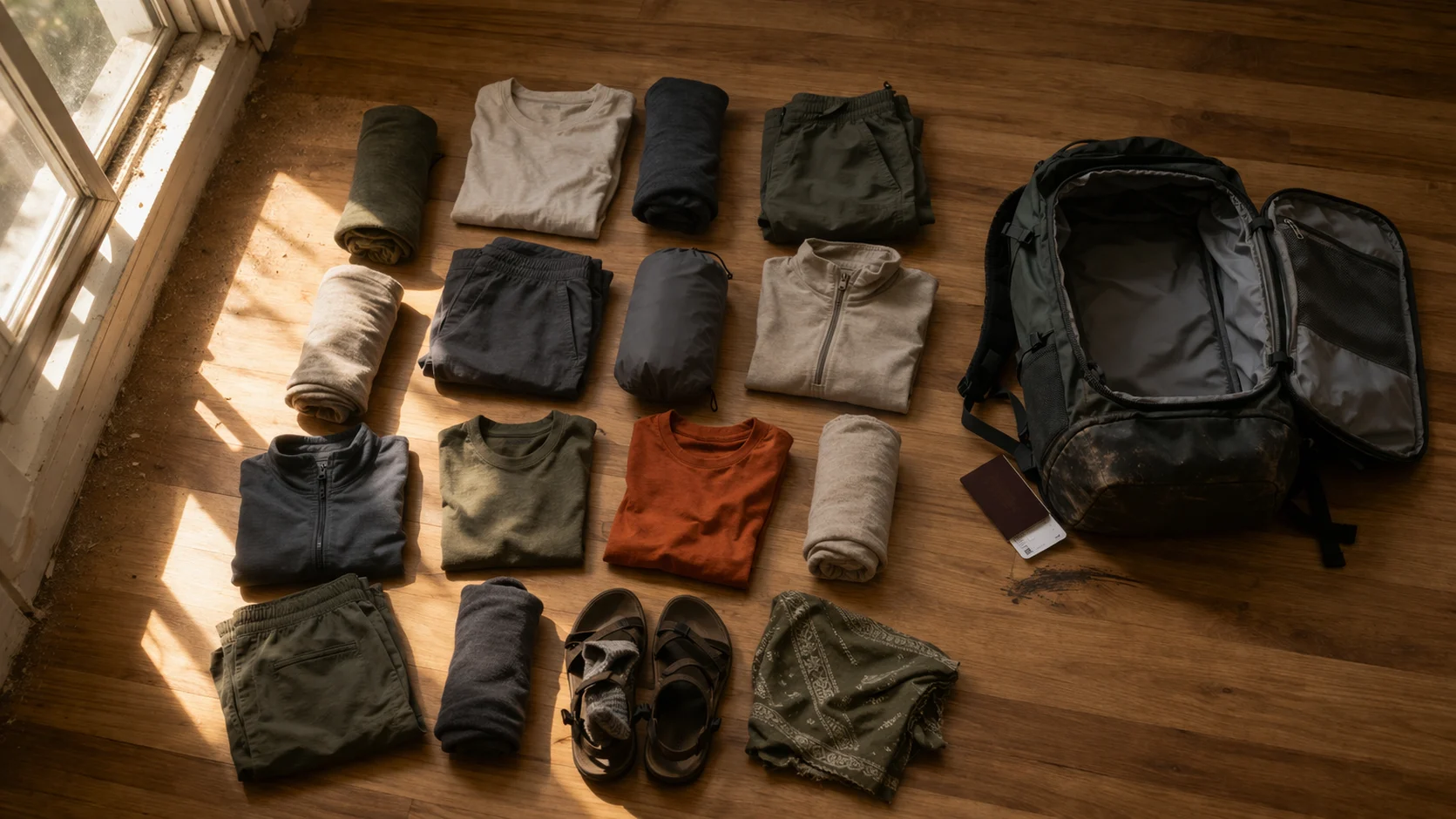
- The Capsule: 15 Items, Under 2.5 kg Clothing Weight
- Outfit Scenario Builder
- Backpack Reality Check: Does It Actually Fit?
- Osprey Farpoint vs Fairview: Which One?
- The Week 3 Maintenance Protocol
- Variations: Adjust for Your Trip
- Your Pre-Trip Checklist
- Frequently Asked Questions
Why Most Travel Capsules Fall Apart by Week 2
The standard advice for any capsule wardrobe backpacking setup — “pick 10 neutrals that all go together” — isn’t wrong. It’s just incomplete. It doesn’t account for the specific ways travel breaks clothing systems that work fine at home.
Wrong fabrics. Linen looks beautiful on day 1 and like a crumpled grocery bag by day 3. Cotton holds odour after two wears in humid heat. Most “quick-dry” athletic fabrics perform well but look overtly sporty — fine for the trail, wrong for a dinner in Lisbon. The fabric has to earn both performance and aesthetics simultaneously.
Wrong palette logic. All-black capsules feel fail-safe but produce visual monotony fast — every outfit looks identical in photos, and cheap fabrics show pilling and wear more visibly in dark colours.
Built for 10 days, not 4 weeks. Most capsule guides assume frequent laundry access or short trips. A 4-week slow trip through Italy and Portugal means your pieces need to rotate across more wears, handle more sink-washing cycles, and still look elevated at week three. This changes which fabrics you choose and how many bottoms you actually need.
No maintenance plan. Even a perfect capsule degrades without a system. Knowing which items to wash first, what dries in 4 hours versus overnight, and how to refresh a worn item between washes is what separates a capsule that holds up from one that doesn’t.
The Palette Formula That Actually Generates Looks
Before picking items, set your palette. This single decision determines how many usable outfits you actually get from your capsule. The formula that works for a minimalist travel wardrobe — and for any capsule wardrobe travel build you’ll find worth keeping:
- 2 neutral bases — one light (cream, sand, stone), one mid-tone (slate, olive, warm taupe). These form the backbone of every outfit.
- 1 dark anchor — navy or charcoal (not black — it’s harder to match across fabric textures and shows wear faster). This grounds every outfit.
- 1 accent — one colour that lifts the whole capsule. Terracotta, forest green, burgundy, dusty blue. One item in this colour produces visual variety without adding pieces.
A concrete example that works well: cream + olive + navy + terracotta. Every combination from those four reads as a coherent outfit — the terracotta shirt over olive chinos, navy trousers with cream tee, olive long-sleeve under a navy shell. One accent colour breaks the visual repetition without complicated mixing rules, and it’s the reason an all-neutral capsule always starts to feel monotonous by week two.
Before packing, lay out every item and ask: does this touch at least 3 other pieces? If not, it doesn’t earn its place.
The Fabric Rules That Actually Hold Up
The fabric conversation has moved on. “Merino wool” is table stakes now — the real question is which blends and which brands look elevated rather than athletic or outdoor-technical. Merino wool’s natural fibre structure gives it odour resistance and temperature regulation that synthetic fabrics can’t replicate at the same weight. Here’s the performance hierarchy for a capsule wardrobe backpacking context:
| Fabric | What to look for | Best for | Honest trade-off |
|---|---|---|---|
| Merino wool (150–200gsm) | 18.5–19.5 micron, fine knit — not heavyweight outdoor merino | T-shirts, lightweight layers, base tops | More expensive. Some brands still look sporty — check the cut. |
| Merino/Tencel or merino/bamboo blend | 60–70% merino, rest Tencel or bamboo | Shirts, lightweight polos, any top worn for dinner | Slightly less odour-resistant than pure merino but drapes better and looks more elevated. |
| Nylon/spandex stretch woven | At least 5% elastane, matte finish (not shiny) | Trousers, chino-style bottoms | Looks polished, survives 12-hour buses without creasing, hand-washes and dries overnight. |
| Recycled polyester microfibre | Matte finish, mid-weight (not see-through) | Packable jackets, lightweight mid-layers | Can look cheap in low-quality versions. Stick to structured cuts. |
| Cotton (limited use) | Only if pre-washed, worn infrequently | One casual shirt maximum | Holds smell, takes too long to dry. One cotton item is fine; building a capsule on it isn’t. |
Brands worth knowing: Unbound Merino and Woolly Clothing for merino tops that look like regular shirts. Western Rise and Bluffworks for stretch nylon trousers that pass a dress-code test. Vuori and Patagonia for packable mid-layers that look less technical than Arc’teryx. After testing several of these across trips, the cost-per-wear math on a £120 merino top worn 40+ times beats a £30 cotton one worn twice and left behind.
The Capsule: 15 Items, Under 2.5 kg Clothing Weight
The silhouettes here are intentionally ungendered — choose cuts that fit how you dress, and let the fabric logic and item count do the work. What doesn’t change: the weights, the fabric rules, and the rotation.
| Item | Qty | Fabric | Function | Est. Weight |
|---|---|---|---|---|
| Merino crew-neck tee — neutral base #1 | 2 | 150–175gsm merino | Everyday base layer. Wears 3–4 days between washes. Packs to fist-size. | ~160g each |
| Merino/blend shirt or button-down — accent colour | 1 | Merino/Tencel blend | Elevates any outfit for dinner or a museum. Works open over a tee. Your one colour item. | ~200g |
| Lightweight long-sleeve — neutral base #2 | 1 | Merino or bamboo blend | Cool evenings, early starts, church cover-up. Layers under everything. | ~180g |
| Stretch woven trousers — dark anchor | 1 | Nylon/spandex, straight or slim cut | Works for 15k-step days and dinner. Survives buses without creasing. Hand-washes, dries overnight. | ~280g |
| Chino or pull-on trouser — mid-tone neutral | 1 | Cotton/nylon blend or technical cotton | Your everyday bottom. More relaxed than the stretch trousers. | ~300g |
| Shorts or skirt — light neutral | 1 | Quick-dry nylon or merino jersey | Hot days, beach, downtime. Doubles as sleepwear if shorts. | ~150g |
| Packable mid-layer — neutral or dark anchor | 1 | Recycled fleece or light down | Evening chill, cold museums, AC. Packs to palm-size. Non-negotiable for shoulder-season Europe. | ~220g |
| Packable shell or rain layer | 1 | Nylon, packable | Sudden rain in Florence, cold wind on the Lisbon waterfront. Doubles as wind layer on early trains. | ~200g |
| Versatile dress or one-piece (optional swap) | 1 | Jersey or merino blend | One item that produces 3–5 distinct outfits depending on layer and shoes. Substitutes for the shorts on warmer-climate trips, or replaces a merino tee slot for lighter packers. Not an addition — a swap. | ~220g |
| Everyday walking shoes — neutral | 1 pair | Leather or leather-look upper, cushioned sole | 15k steps, cobblestones, casual dinner. No trainers unless they’re clean white. | ~600g |
| Packable sandals or backup flat | 1 pair | Leather or minimal | Hostel showers, beach, warm evenings. Packs flat. | ~200g |
| Merino underwear | 3 pairs | Merino | Wash one, wear one, drying one. Go to 4 pairs for longer trips. | ~50g each |
| Merino socks | 3 pairs | Merino, mid-weight | Same rotation logic as underwear. One pair of ankle socks for sandal days. | ~60g each |
| Lightweight scarf or sarong | 1 | Merino or modal | Church cover-up, beach towel, pillow on overnight buses, extra warmth. The highest versatility-to-weight item in any capsule. | ~100g |
Total clothing weight estimate: approximately 2.3–2.6 kg depending on shoe choice. That leaves 6–7 kg of budget in a 7–10 kg carry-on allowance (airline dependent) for your bag, tech, toiletries, and documents.
After testing, here’s what I cut: a second pair of shoes “for nicer dinners” (the leather everyday shoe handles it), a fourth top (unnecessary with the right fabrics), a dedicated gym outfit (merino tee + shorts covers it), and a beach towel (the sarong replaces it entirely).
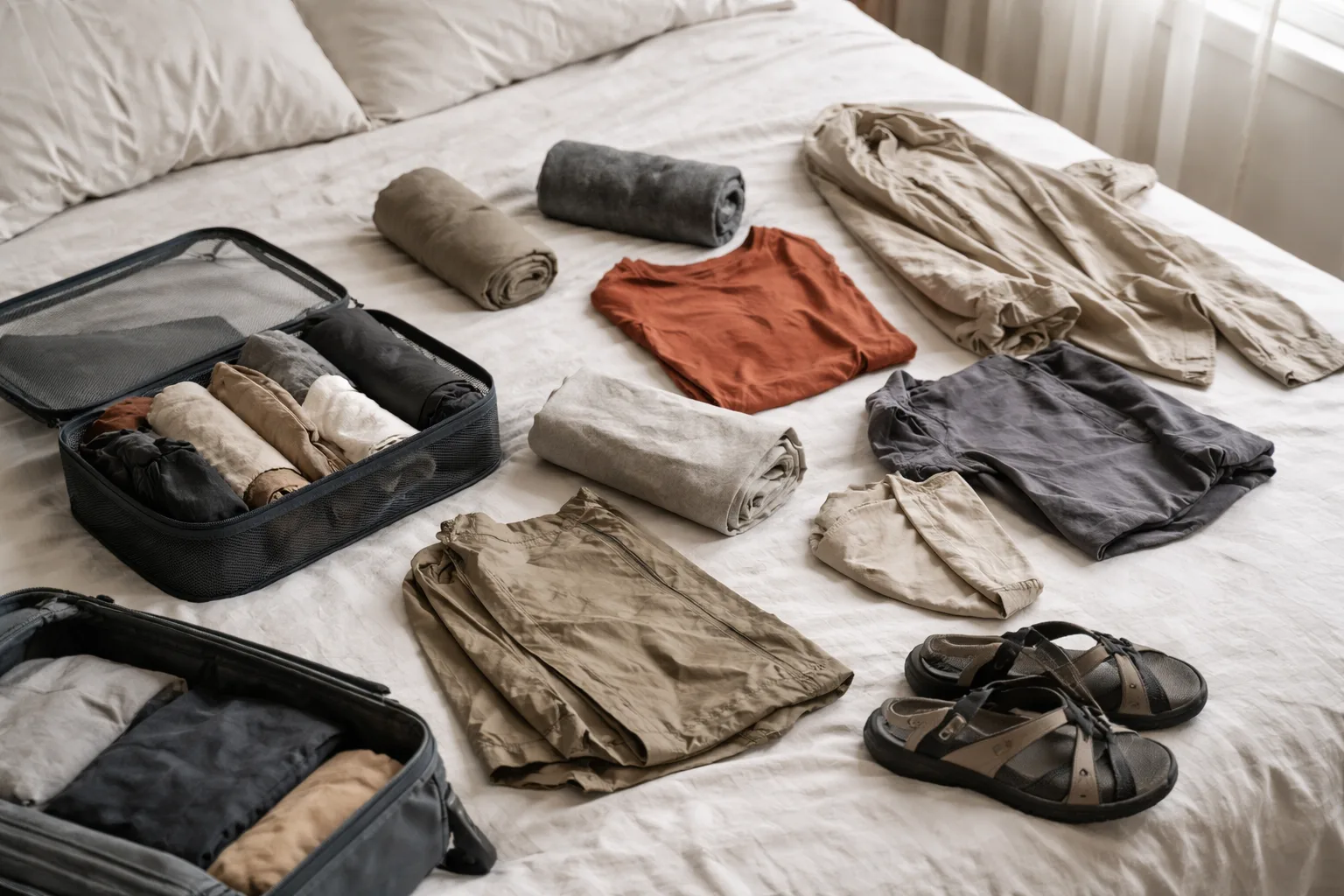
All 15 items fit. The more interesting question is how they combine — here’s the system in action across every real situation you’ll face on a 3–5 week trip.
Outfit Scenario Builder
Pick your scenario below — get the exact outfit for that moment, plus a specific tip for making it work.
One at a time; click any button to switch.
Select a scenario above to see the outfit.
Backpack Reality Check: Does It Actually Fit?
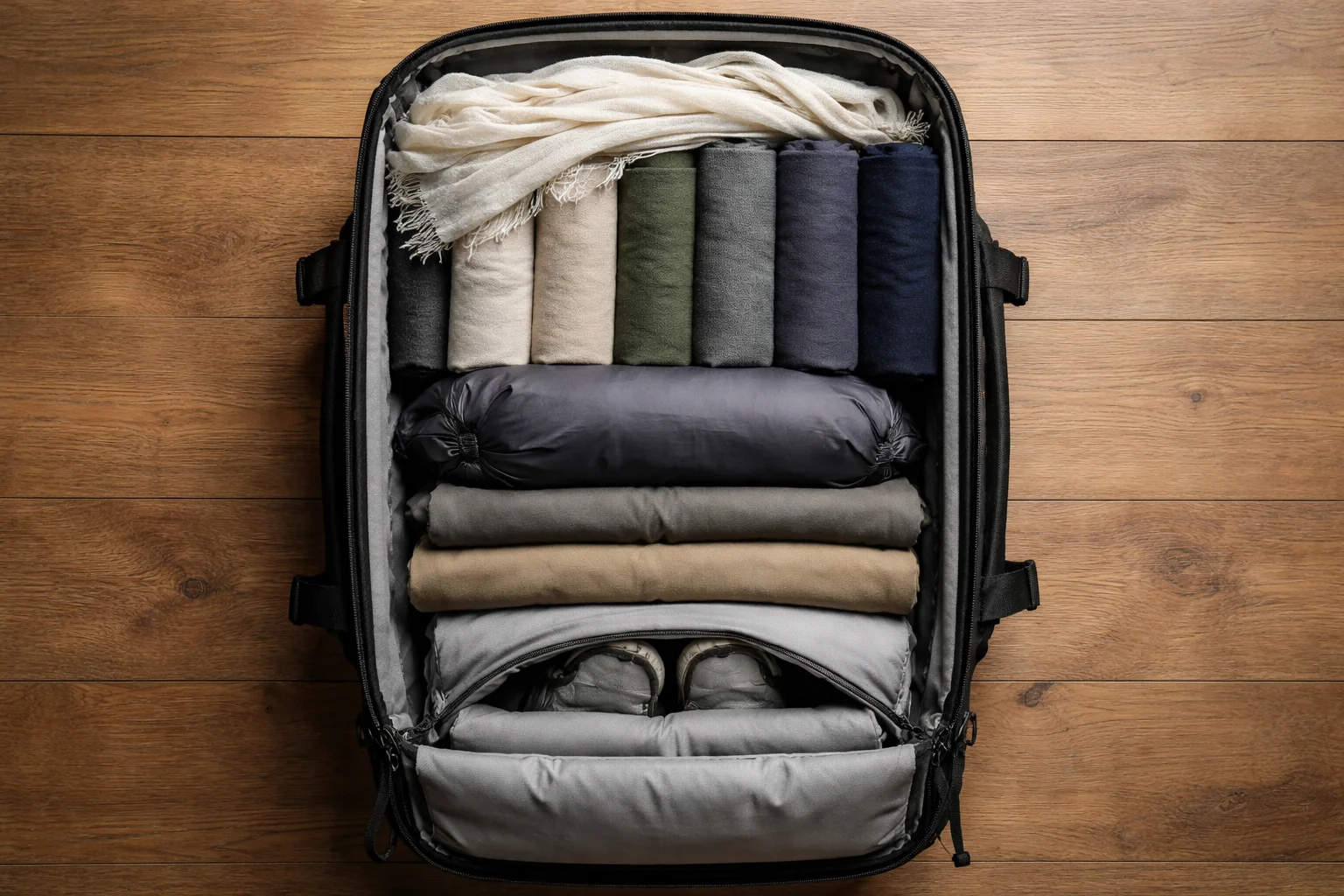
The standard capsule guide stops at the list. Here’s what packing 15 items into a 40–45L actually looks like.
Backpacks this system fits comfortably in: Osprey Farpoint/Fairview 40, Aer Travel Pack 3, Peak Design Travel Backpack 45L, Tortuga Setout 45L. It also fits in the 35L versions of most of these — you’ll just pack tighter. I’ve used this setup in the Farpoint 40 and the Aer Travel Pack 3; both handle the full 15-item capsule without needing compression packing cubes, though a single slim cube for tops is useful if you want everything visible at once.
The Pack That Carries This System
VSQuick pick: Farpoint for men, Fairview for women — same bag, different fit. Both handle 15 items without compression cubes.
| Format | OSPREY FARPOINT 40L | OSPREY FAIRVIEW 40L |
|---|---|---|
|
Fits the full 15-item capsule — clothes, shoes, toiletries, tech — with room for a day layer. |
Same internal volume as the Farpoint, cut for a woman’s torso length and hip shape. |
|
| Why choose |
|
|
| Pros |
|
|
| Consider |
|
|
| Shop |
Pack Order (bottom to top)
- Shoes: Wrapped in a shoe bag or shower cap, packed against the back panel at the base. Heaviest item, closest to your spine.
- Trousers: Both pairs folded flat and laid across the full width — they form a base layer and cushion shoes.
- Mid-layer and shell: Compressed into their own stuff sacks. Sit flat on top of trousers.
- Tops: All merino tops rolled tightly (not folded). Stack vertically like files — you can see everything and grab one without unpacking.
- Underwear and socks: Rolled pairs tucked into shoe gaps and corners. No wasted dead space.
- Dress/one-piece: Folded in half once, slid along the side panel.
- Sandals: Packed flat in the front pocket or outer compartment — never inside with clothes.
- Scarf: Last in, first out — top layer. Also works as a packing pad to stop items shifting.
With this order, the bag is roughly 70–75% full. The remaining space holds a packing cube with toiletries, your tech pouch, and documents. Nothing is crushed. You can find any item without unpacking everything.
The Week 3 Maintenance Protocol
A capsule wardrobe for travel doesn’t stay a capsule wardrobe if everything looks tired by week three. This is the system that keeps 15 items looking fresh for 4–6 weeks. And if you genuinely can’t access laundry for 5 or more days — rural areas, back-to-back transit — merino tops and underwear will carry you through. The odour resistance is real, not marketing.
Wash priority order (sink-wash first, laundromat if available)
- Underwear and socks: Every 1–2 days. Quick rinse, wring hard, hang anywhere. Merino dries in 2–4 hours in a warm room.
- Merino tees: Every 3–4 days — merino genuinely holds off odour this long. Hand-wash with a squeeze of shampoo or travel soap, press against the tile (don’t wring — it distorts the knit), hang flat or on a radiator. Dry overnight.
- Trousers: Every 5–7 days. Nylon/spandex dries in 3–4 hours. Spot-clean between washes — a damp cloth handles most food splashes.
- Mid-layer and shell: Every 10–14 days. Air them out instead of washing where possible.
Quick-refresh tricks between washes
- Steam in the shower: Hang the item in the bathroom while you shower. 10 minutes of steam removes light creasing and refreshes odour-neutral fabrics. Works especially well on trousers.
- Fabric spray: A 50ml travel bottle with diluted white vinegar (1:4 with water) neutralises odour on any fabric without washing. Spray lightly, let dry. Undetectable after 10 minutes.
- Air on the windowsill: Hanging items in direct sunlight for 2–3 hours kills surface bacteria and refreshes fabric. Often better than a wash for items that don’t smell.
- The radiator test: Before booking, check if your accommodation has radiators. A warm radiator dries a merino tee in 90 minutes — I’ve timed it. On cold-month Europe trips this single variable changes your whole wash schedule; it’s worth filtering for on Booking.com.
Variations: Adjust for Your Trip
If your trip is 10–14 days:
Drop one merino tee and the sandals. Add a second accent piece — a light patterned item or a bold accessory. Shorter trips mean less laundry need, so more outfit variety is worth the small weight trade-off. If you’re still figuring out what to wear backpacking for shorter Europe trips, this leaner version is the better starting point.
If you’re heading to Southeast Asia instead of Europe:
Swap the mid-layer for a second lightweight layer (linen-look or bamboo blend — humidity makes fleece miserable). Upgrade the sandals to a more durable pair since you’ll wear them daily. Drop the packable shell — a small umbrella is more useful than a rain jacket in tropical rain.
If the dress/one-piece doesn’t work for your style:
Swap it for a second merino tee in your accent colour or a linen-look shirt — you get the same outfit count from extra layering options. The dress slot in the capsule is a versatility position, not a garment requirement.
If you run cold:
Replace the recycled fleece mid-layer with a lightweight down jacket. Same pack size, significantly more warmth. Add a second pair of merino socks.
Your Pre-Trip Checklist
- Palette confirmed: 2 neutral bases + 1 dark anchor + 1 accent colour
- Every item touches at least 3 others in the palette
- All fabrics scrunch-tested and wash-tested before packing
- Total clothing weight checked (<2.6 kg target before shoes)
- Shoes packed and tested for 15k-step days
- Travel soap or shampoo for sink-washing in kit
- Fabric spray / diluted vinegar in 50ml bottle
- Packing order followed: shoes → trousers → layers → tops (rolled) → small items → scarf
- Outfit matrix reviewed — at least 15 documented looks confirmed before you leave
- Week 3 wash rotation understood: underwear/socks every 1–2 days, tops every 3–4
If you’re building the full one-bag system beyond clothing, the next step is getting the bag right — see the best carry-on backpack for travel guide for which bags this capsule fits best, and the full backpacking packing list for everything that goes around the clothes.
Frequently Asked Questions
Conclusion
Get the palette right, choose fabrics that earn their place on performance and aesthetics simultaneously, and know your maintenance rotation before you leave. Do those three things and 15 items will carry you further than 30 ever did.
No emergency shirt purchases in Valencia. That’s the whole point — the system disappears, and what’s left is the trip.