
Last updated: June 2026.
The €18 dorm bed in Porto saved me €47. It also cost me a full day of energy, a ruined first impression of the city, and a quiet crisis about why I was still doing this to myself.
I was 31, had a real job, and was still optimizing like I was 22 and broke. The dorm smelled like someone else’s dinner. The Wi-Fi dropped every hour. The guy in the bunk above me got up at 5am and packed a full hiking kit — zipper by zipper — in complete darkness. I lay there calculating whether I’d “saved enough” to justify the misery. I hadn’t.
That trip rewired how I think about travel cheap tips. Travel cheap doesn’t mean travel rough — it means spending deliberately on what actually improves the trip while cutting everything else. That’s the luxury way to travel cheaper, and it’s where frugal travel tips actually differ from the usual “dorm beds and overnight buses” advice. Not “how do I spend less?” but “where does money actually buy something worth having, and where is it just friction tax?”
Spending strategically — cutting what you won’t notice, optimizing where the comfortable option and the cheap option are the same thing, upgrading the things that actually change how the trip feels — is what lets me do three solid trips a year without feeling broke, deprived, or like I’m back in a bunk at 31. The framework below is the repeatable version of that shift.
These ideas slot directly into the backpacking hacks system.
Table of Contents
- Why Most Travel Cheap Tips Are Wrong
- The 3-Bucket System
- Bucket 1: Cut — What You Won’t Miss
- Bucket 2: Optimize — Same Comfort, Lower Price
- Bucket 3: Upgrade — Where Spending Changes Everything
- Accommodation Deep Dive
- Group & Couple Hacks
- Case Study: 10 Days in Portugal
- The Spend / Optimize / Cut Reference Table
- Budget Allocator Tool
- Frequently Asked Questions
Why Most Travel Cheap Tips Are Wrong
Most budget travel advice is written for one type of traveler: someone who wants to minimize spend at all costs and is willing to sacrifice comfort to do it. Cook every meal. Overnight bus everywhere. Hostels always.
That’s not a budget strategy. That’s a misery strategy.
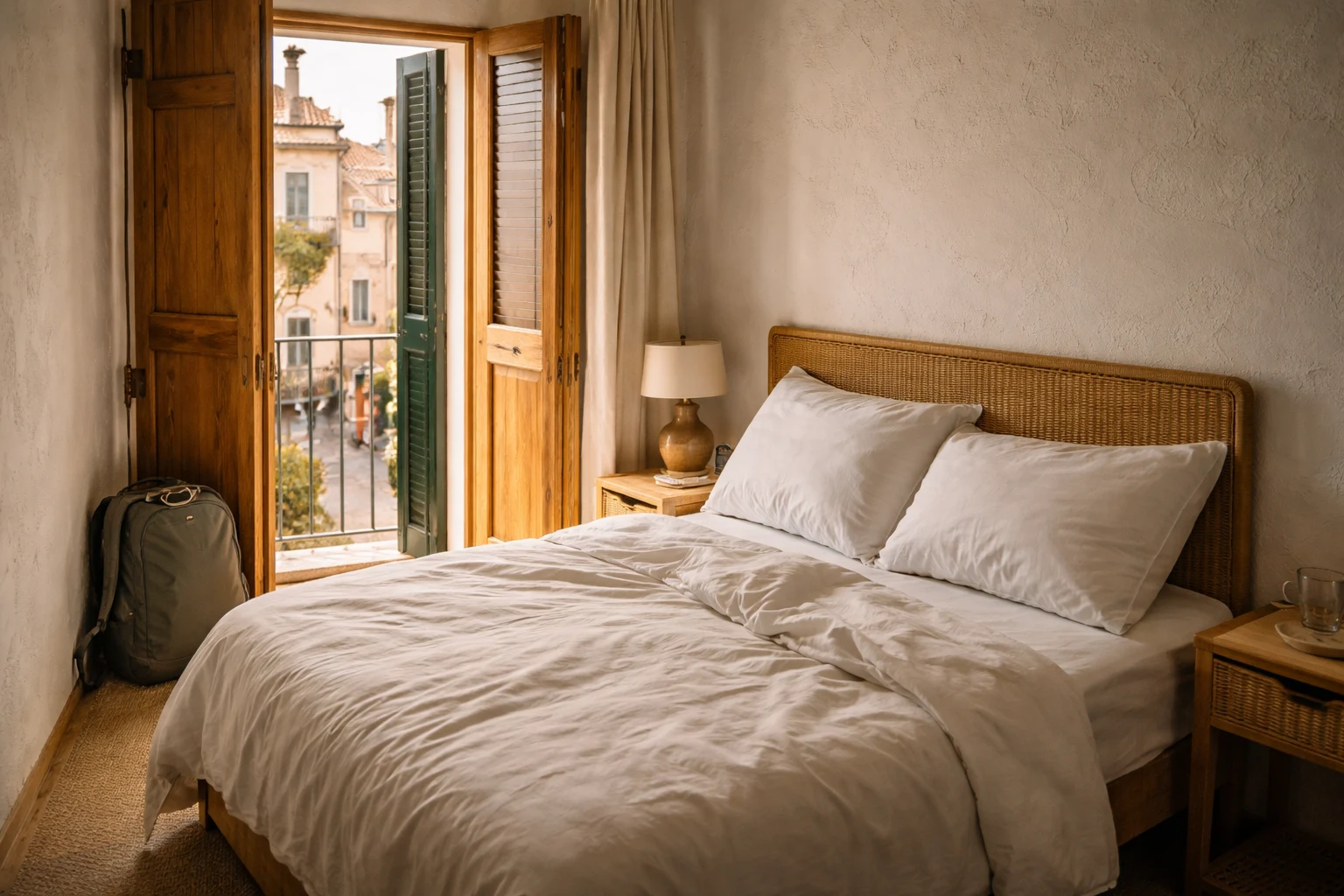
The problem isn’t the advice itself — it’s that it treats all travel expenses as equal. They aren’t. Saving €47 on a bed that wrecks your sleep, ruins your first morning, and costs you half a day of recovery isn’t saving anything. It’s a false economy. You paid for a bad experience.
Real strategic spending starts with a different question: which expenses deliver comfort, and which ones just feel like they should? Frugal travel tips that treat every euro as equal miss this entirely. The answer changes everything about how you plan. As NPR’s Life Kit travel budgeting guide puts it, spending more time in a place and more money on a trip doesn’t automatically add up to a better experience — the key is knowing where the spend actually lands.
The 3-Bucket System
Every travel expense falls into one of three buckets. Once you know which bucket something belongs in, the decision is usually obvious.
- Cut: Expenses that don’t affect your comfort, energy, or experience. You genuinely won’t notice they’re gone. Cut these ruthlessly.
- Optimize: Expenses where the cheapest option and the comfortable option are actually close — you just need to find the right version. A little effort here buys significant savings without any quality loss.
- Upgrade: Expenses where paying more has a direct, measurable impact on how your trip feels. Sleep. Location. One real experience per city. These are worth spending on.
The mistake most travelers make is applying the same strategy to everything — either cutting across the board (misery) or spending freely (guilt). The 3-bucket system forces you to think per category, not per trip total.
Bucket 1: Cut — What You Won’t Miss
Convenience laziness
The biggest silent drain on any travel budget isn’t accommodation or flights. It’s convenience tax — the extra €4 for the airport sandwich, the €12 tourist-trap coffee you grabbed because you didn’t plan the morning, the Uber you took because you didn’t check if a metro existed. None of these individually break the budget. Together, over a two-week trip, they routinely add €200–400 to a bill and deliver nothing worth having.
The fix isn’t to never buy anything convenient. It’s to spend five minutes the night before planning the first two hours of tomorrow. Know where you’re eating breakfast and how you’re getting to the first thing on the list. That one habit alone cuts most convenience tax.
Peak-season pricing on the wrong things
Shoulder season travel is consistently one of the clearest wins — not because it’s a hack, but because the math is straightforward. Porto in October versus Porto in July: same city, same food, same wine, 30–45% lower accommodation costs, half the crowds at every site, and often better weather for walking.
Transport status games
The €9 regional train versus the €47 high-speed rail covers the same 2-hour route. The scenic bus from Chiang Mai to Pai is one of the best journeys in Thailand and costs €3. Not every journey needs to be optimized for speed. Figure out which legs of your trip matter (airport arrivals when you’re tired, overnight routes when sleep counts) and which ones are just movement. Spend on the former. Cut the latter.
Checked luggage fees
Flying carry-on only cuts €25–60 per flight on most European carriers and eliminates the 20-minute baggage claim wait at the end. It also forces better packing decisions, which compound across a multi-city trip. Most two-week itineraries fit in a 40L bag with a modular outfit system — and you move through airports, trains, and neighbourhoods faster for it.
Bucket 2: Optimize — Same Comfort, Lower Price
Optimize is where most of the real savings live — not through sacrifice, but through better information. If you’re thinking about how to save money for travel without feeling like you’ve downgraded, this is the bucket that does most of the work. These are the cases where the comfortable option and the cheap option are actually the same thing. Worth noting before diving in: a travel credit card with a hotel or flight credit, used consistently on everyday spend, typically offsets one to two nights per year as a passive side effect of normal spending — worth having in place before you start booking, not after. Everything below is about the actual booking decisions.
Neighbourhood arbitrage
This tactic is almost universally overlooked. Every major city has a tourist-price neighbourhood and a five-minute-walk-away neighbourhood that charges 40–60% less for equivalent quality. In Lisbon, Alfama gets the premium — comparable boutique guesthouses in Mouraria, one tram stop away, run €65–75/night versus €110–130 in Alfama. Same walk time to the major sights. Better local atmosphere. In Bangkok, the Sukhumvit tourist corridor charges double what you’d pay in Ari or Ekkamai for the same private room quality.
If you’ve ever paid the tourist-zone premium and spent the week watching tour groups file past your window, you already know the downside. The research to avoid it takes 20 minutes. Open a map, identify the main tourist clusters, then search one or two adjacent neighbourhoods. Filter for 8.5+ rating, private en-suite, and check the walk time to transit. That’s usually enough to find the optimized version of the same stay.
Property age discounts
New hotels and guesthouses almost always price below their eventual market rate for the first 6–18 months. They need reviews. They need occupancy. A boutique that opened six months ago and has 40 reviews typically runs 25–35% below an equivalent property with 400 reviews — in practical terms, that’s €55/night versus €80/night for a very similar private room. I found this one almost by accident, after booking a six-month-old guesthouse in Chiang Mai that turned out to undercut its identical neighbor by €25/night for no reason other than needing the reviews — and the room was newer. The quality is often better: everything is still fresh, the owner is personally invested, and the service tends to be attentive because they can’t afford bad early reviews. On Booking.com, sort by Review Score and filter for recently opened properties. On Airbnb, the New Listing filter surfaces the same pattern.
Flight timing and flexibility
Three things that consistently move the needle on flight costs — covered in more detail in these cheap flight hacks — are: flying Tuesday–Thursday instead of Friday–Sunday (typically 15–25% lower on international routes), booking 6–10 weeks out for European short-haul, and using flexible date search to find the cheapest 3-day window around your target dates. None of these require a points obsession. They just require not booking at peak convenience.
Long-stay discounts
Staying 7+ nights almost always unlocks a rate that beats a shorter hotel booking. After testing this on back-to-back trips to the same city — one with 3-night hotel bookings, one with a 10-night apartment — the difference was €31/night for equivalent comfort, plus a kitchen that cut breakfast costs to near zero. Slow travel isn’t just a lifestyle choice. The economics are genuinely better.
Bucket 3: Upgrade — Where Spending Changes Everything
The best luxury travel tips aren’t about finding the fanciest option — they’re about identifying the two or three upgrades that shift the entire feel of a trip. For most travelers, those are sleep, location, and one experience that’s specific to the place.
Sleep quality is non-negotiable
This is the one upgrade that pays dividends every single day of the trip. A bad night’s sleep at €18 costs you energy, mood, and recovery time. A private room with blackout curtains, decent AC, and a real mattress at €65 makes the next day genuinely better. Over a two-week trip, the compounding effect of good sleep versus bad sleep is enormous — more miles covered, more present, more willing to explore.
The threshold isn’t “expensive hotel.” It’s: private room, en-suite bathroom, reliable AC, 8.5+ rating, in a neighbourhood where you can walk to something. That combination usually runs €55–85/night in Western Europe and €30–55/night in Southeast Asia. It’s not luxury pricing — it’s just not hostel pricing either.
Location over size
A smaller room in a central, walkable neighbourhood is almost always worth more than a larger room 40 minutes from everything. Location compounds. Every time you don’t need a taxi, every time you can walk back after dinner, every time you spot something interesting because you’re in the right part of the city — those are invisible returns on the location upgrade. A 20m² room in the right neighbourhood beats a 35m² room that requires a commute to reach the city.
One real experience per city
The luxury backpacking approach to activities isn’t “do everything” and it isn’t “do the free stuff only.” It’s one genuinely good, paid experience per city that you’ll actually remember. The cooking class in Chiang Mai, the boat to the private beach in Hvar, the wine tasting at the small producer in the Douro Valley. Budget for it. Plan for it. Cut the mediocre stuff around it to fund it. One real experience per city costs less than three half-hearted ones, and the return is incomparable.
Travel insurance — the upgrade most people skip
Most travel insurance is a Cut — the €18 policy that covers nothing useful and exists mainly to tick a box. The version worth buying covers trip interruption, cancelled flights, lost luggage, and emergency rebooking. That runs €40–70 per trip and pays for itself the first time something goes sideways. If you’re traveling with non-refundable bookings, it’s not optional.
That’s the whole framework — Cut, Optimize, Upgrade, applied to every line in your budget. If you’d rather work through it as an interactive system instead of scrolling back through this post, it’s all in one place:
Free Toolkit →Accommodation Deep Dive: Finding Private Comfort at the Right Price
Accommodation is where the biggest gap exists between what most budget travel advice recommends (hostels) and what actually works for travelers who’ve moved past that phase. The goal isn’t the cheapest bed — it’s the best private comfort-per-euro. In my experience, this search logic finds the right room in under 20 minutes.
Platform filter stack: On Booking.com, filter for private room or entire apartment, 8.5+ Guest Review Score, and free cancellation — then sort by Top Reviewed. On Airbnb, filter for Entire Place, 4.8+ rating, and Superhost. Run both platforms for the same dates. They surface different properties at different price points and the gap is often significant. For a deeper breakdown of how to find these, see this guide to boutique hotels on a budget.
7-night search for shorter stays: Even if you’re staying 4 nights, search with 7-night parameters and message the host directly for a shorter-stay rate. Most will negotiate rather than leave the dates empty. The longer search window also surfaces better properties — platforms tend to bury shorter-availability listings.
Check-in day arbitrage: Prices shift by day of arrival on most platforms. Arriving Tuesday versus Sunday on the same week routinely moves the per-night rate 10–20%. Takes 30 seconds to check before committing to dates.
Group & Couple Hacks: The Economics of Traveling Together
Most travel cheap tips are written for solo travelers. If you’re traveling as a couple or in a group of three or four, the economics shift significantly — and usually in your favour.
Group travel is where the affordable luxury vacation concept becomes genuinely attainable — see the full backpacking Southeast Asia guide for villa split logistics — not as a compromise but as a structural advantage. The villa split: A private villa or apartment that sleeps four in Bali runs €120–180/night total. Split four ways, that’s €30–45 per person per night — cheaper than most decent hostels in the same area, with a private pool, kitchen, and nobody else’s alarm at 6am. The villa split is arguably the best-value luxury upgrade available to group travelers and almost nobody talks about it in a travel tips context.
Couple room math: Two people sharing a private double at €75/night pay €37.50 each. A solo traveler in a dorm pays €20 and gets a fraction of the comfort. The couple upgrade to a private room with a view costs €15 more per person and eliminates every dorm downside. The math almost always works once you run it.
Navigating different spending thresholds: If one person in a couple or group has a higher comfort threshold, establish a “baseline” standard that everyone pays equally (private room, central location) and a “personal upgrade” category where individual preferences are paid individually. This structure removes the tension from most travel planning disagreements.
If you’re planning trips together more seriously, this guide on backpacking as a couple breaks down how to align budgets and travel styles without friction.
Case Study: 10 Days in Portugal
Here’s the part that surprised me: running the framework doesn’t just lower the bill — it often upgrades the trip at the same time. These aren’t generic luxury travel hacks recycled from a listicle; they’re the actual decisions from a real 10-day trip, side by side.
Before the system — instinctive booking
| Category | Approach | Cost |
|---|---|---|
| Flights | Booked Friday, peak window | €340 |
| Accommodation | 3★ hotel, tourist district, 10 nights | €950 |
| Food | Unplanned, tourist-area restaurants | €420 |
| Transport | Taxis + tourist buses | €180 |
| Activities | 4 paid tours, mixed quality | €210 |
| Total | €2,100 |
After the system — 3-bucket approach
| Category | Approach | Cost | Change |
|---|---|---|---|
| Flights | Tuesday departure, 8 weeks out | €215 | −€125 |
| Accommodation | Boutique guesthouse, Mouraria, 10 nights @ €68/night | €680 | −€270 |
| Food | Pastelarias for breakfast, 1 proper dinner/day, 2 splurge meals | €290 | −€130 |
| Transport | Metro + tram + 2 taxis | €55 | −€125 |
| Activities | 1 Douro Valley wine tour, rest free/low-cost | €95 | −€115 |
| Total | €1,335 | −€765 |
The result: Better sleep every night (boutique guesthouse vs. generic hotel), better location (Mouraria vs. tourist district), one genuinely memorable experience (Douro Valley), and €765 less spent. The trip felt more expensive than the previous one. It wasn’t.
That’s the entire system, run once, in real life. The table below breaks the same logic into something you can actually scan from a hotel lobby in thirty seconds.
The Spend / Optimize / Cut Reference Table
Bookmark this part. For the full gear and tech stack that makes all of this smoother, see the smart travel upgrades guide.
| Category | Strategy | Why |
|---|---|---|
| Accommodation | Upgrade — sleep quality + location | Compounds every day. Bad sleep ruins trips. |
| Flights (timing) | Optimize — Tue–Thu, 6–10 weeks out | Same flight, meaningfully lower price. |
| Flights (route) | Cut — skip speed on non-critical legs | Regional train or scenic bus = same or better. |
| Food | Optimize — local breakfast + 1 real dinner | Pastelaria > hotel buffet. One good meal beats three mediocre ones. |
| Activities | Upgrade — one memorable experience per city | Budget for the one that counts. Cut the rest. |
| Ground transport | Cut — metro/tram default | Taxis only for airport arrivals when tired. |
| Neighbourhood | Optimize — one stop from tourist centre | 40–60% lower prices, often better character. |
| Convenience purchases | Cut — plan first 2hrs each morning | Removes most convenience tax without any sacrifice. |
| Group travel | Upgrade feel, Optimize price — villa split beats hotel rooms per person | Private pool + kitchen at hostel-level per-person cost. |
| Season | Optimize — shoulder season default | 30–45% lower accommodation, fewer crowds, often better weather. |
If you’ve been mentally sorting your own trip’s expenses into Cut, Optimize, and Upgrade while reading this, here’s where you stop estimating. Plug your numbers in below.
Budget Allocator: Where Should Your Money Go?
Enter your trip details to get a Cut / Optimize / Upgrade spend split.
Prices based on 2025–2026 data.
Frequently Asked Questions
Conclusion
The guy in the Porto bunk above me probably saved €30 that night. I don’t know if it was worth it to him. For me, after one too many mornings starting from a deficit, it stopped being worth it. The 3-bucket system didn’t make travel more expensive — it made it clearer. Once you know which expenses compound and which ones just drain, the decisions get easier and the trips get better. Use the framework on your next booking. Not on everything at once — just pick one thing from each bucket and see what shifts. The €18 dorm bed was never the problem. Spending without knowing why was.
For the full context — why this mindset matters across an entire trip, not just a single booking — see the complete luxury backpacking philosophy. Done right, you travel more, spend less, and still get the private rooms, good sleep, and real experiences that make the trip feel luxurious.
All recommendations are chosen for fit and value for this travel style. Travel costs, platform features, and availability change frequently — verify current prices and conditions before booking. Individual results will vary based on destination, timing, and travel style.