Some links in this post are affiliate links — if you apply for a card through one of them, we may earn a commission at no extra cost to you. We only recommend cards we’d genuinely use for long-term independent travel.
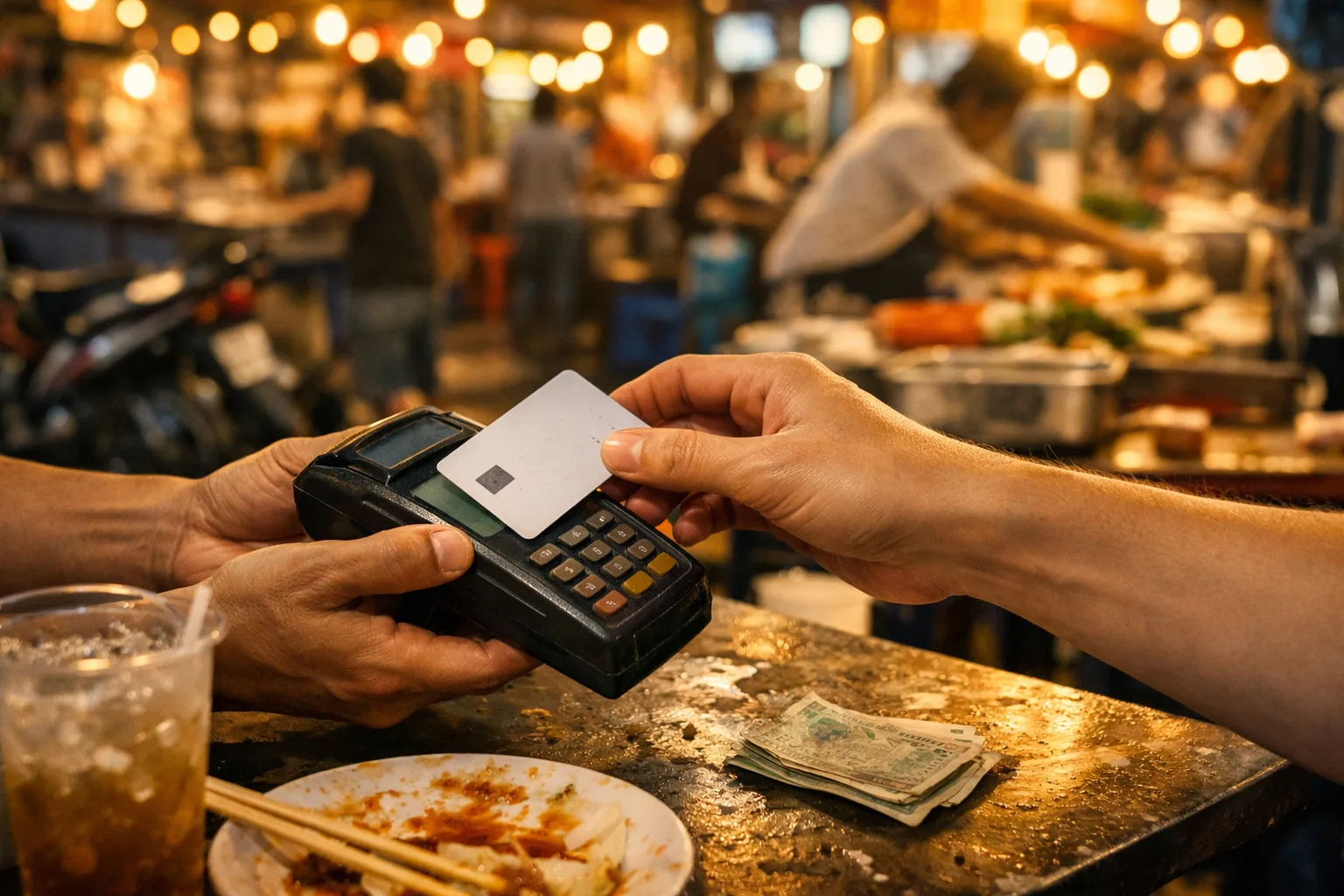
My first trip to Vietnam cost me $212 in hidden fees — not from overspending, but from using the wrong card. Every ATM withdrawal, every hostel booking, every street-food payment quietly bled 3% into my bank’s pocket. Choosing the right no foreign transaction fee cards before I left would have saved every cent of it.
Most guides on this topic bury the answer under premium cards with $95 annual fees and signup bonuses that only matter if you’re flying business class. This guide is for backpackers on $40–70/day who want a simple, practical approach to cutting travel card fees — without the complexity. The full guide that ties all these tools together is our smart travel upgrades guide — insurance, connectivity, payments, and the full system, all in one place.
Table of Contents
- Why You Need Two Cards, Not One
- No Foreign Transaction Fee Cards: Full Comparison
- Foreign Fee Slayer Calculator
- The Cards: What You Actually Need to Know
- SE Asia vs Europe: The Strategy Is Different
- Credit Card Travel Hacks — and Things That’ll Catch You Out
- What Score Do You Need? Application Reality
- Pre-Trip Card Checklist
- Frequently Asked Questions
- Conclusion
Why You Need Two Cards, Not One
The first mistake most backpackers make is looking for one card that does everything. It doesn’t exist — not for our use case.
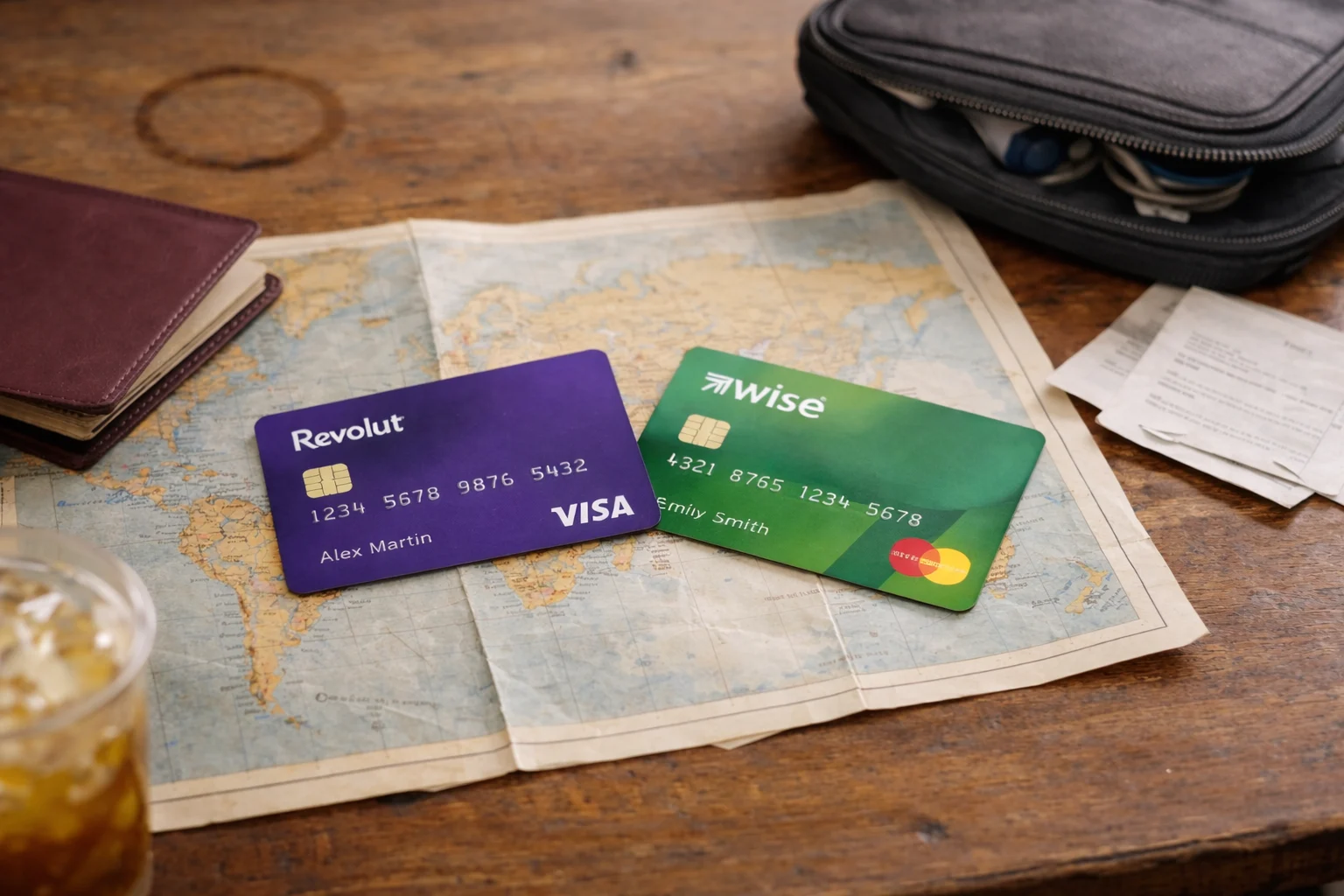
Credit cards and fintech cards (Wise, Revolut) solve different problems. A credit card with no foreign transaction fee handles purchases; fintech handles cash and conversion rates.
Credit cards are better for: hostel bookings and large online purchases (chargeback protection), rental-car insurance, purchase protection on gear, building credit history, and any merchant that only accepts credit.
Fintech cards (Wise/Revolut) are better for: daily cash at ATMs, small local transactions, and — this is what most articles skip — getting the actual best exchange rate.
Here’s the hidden cost of no foreign transaction fee cards: no FTF does not mean the best exchange rate. This matters a lot when choosing the right credit card for international travel. Most credit cards use the Visa or Mastercard network rate, which is typically 0.5–1% worse than the mid-market rate (the real rate you see on Google). Wise uses the mid-market rate directly. The Consumer Financial Protection Bureau notes that foreign transaction fees are usually a percentage of the transaction — and even “fee-free” cards can embed costs in the conversion spread.
On $4,000 of daily spend over four months, that 1% gap costs you $40. On a backpacker budget, that’s two nights’ accommodation. So the system is simple: use your no-fee credit card for bookings and big purchases. Use Wise or Revolut for ATM withdrawals and daily spending. Two cards, both free or near-free. The Travel Card Stack module in the free toolkit covers how to pair these for zero-fee coverage everywhere.
No Foreign Transaction Fee Cards: Full Comparison
Credit cards and fintech options side by side — this travel card comparison includes the numbers that actually matter. Three of the five credit card options below have no annual fee.
| Card | Annual Fee | FX Fee | Free ATM | Min. Score | SE Asia | Europe | Verdict |
|---|---|---|---|---|---|---|---|
| Wells Fargo Autograph (Visa) | $0 | 0% | N/A (credit) | ~670+ | 8/10 | 9/10 | → Best overall no-fee credit |
| Capital One VentureOne (Visa/MC) | $0 | 0% | N/A (credit) | ~640+ | 8/10 | 9/10 | → Best for thin credit files |
| BofA Travel Rewards (Visa) | $0 | 0% | N/A (credit) | ~670+ | 7/10 | 8/10 | Good if you bank with BofA |
| Discover it Miles | $0 | 0% | N/A (credit) | ~650+ | 3/10 | 6/10 | Poor SE Asia acceptance — backup only |
| Chase Sapphire Preferred (Visa) | $95 | 0% | N/A (credit) | ~700+ | 9/10 | 9/10 | Only worth it if you’ll earn back $95 |
| Wise (debit/prepaid) | $0 (~$9 one-time) | 0% (mid-market) | 2 withdrawals/~$100 free, then ~1.75% | No credit check | 9/10 | 9/10 | Best for daily spend + ATMs |
| Revolut Standard (debit) | $0 | 0% weekdays up to $1k/mo, +1% weekends | No free ATM (2% out-of-network) | No credit check | 8/10 | 9/10 | Good ATM card — watch the caps |
Foreign Fee Slayer Calculator
Enter your trip spend and region split to see your exact savings.
The Cards: What You Actually Need to Know

Wells Fargo Autograph — Best No-Fee Credit Card Overall
Annual fee: $0 · FX fee: 0% · Network: Visa · Credit score needed: ~670+
The Autograph earns 3x points on travel, dining, gas, and streaming — which means hostel meals and transport tickets earn something back. On a $4,200 trip with 60% of card spend in those categories, you’d earn roughly $45–60 in redeemable points. Not life-changing, but free money on spending you’d do anyway.
It’s a Visa, meaning near-universal acceptance in both SE Asia and Europe. No annual fee, no FTF, and approval criteria are reasonable for most applicants above 670.
- Pros: $0 annual fee forever, 3x on dining + travel, Visa acceptance, cell phone protection included
- Cons: No free ATM withdrawals (use Wise for cash), needs ~670 score
Capital One VentureOne — Best for Thin Credit Files
Annual fee: $0 · FX fee: 0% · Network: Visa or Mastercard · Credit score needed: ~640+
Best for: First no-fee travel card if your credit file is new or thin.
The VentureOne is another travel credit card with no annual fee — Capital One approves applicants with limited credit history more readily than most banks. If you’re 22–25 with a thin file and a score of 640–670, this is usually the first card to try. Earns 1.25x miles on everything, 5x on hotels and rentals booked through Capital One Travel. Miles are redeemable as statement credits against travel purchases — simple, no points system to learn.
- Pros: Approves thinner credit files, $0 annual fee, 0% FTF, simple miles redemption
- Cons: 1.25x base rate is modest, lighter travel protections than Chase
Bank of America Travel Rewards — Best If You Already Bank with BofA
Annual fee: $0 · FX fee: 0% · Network: Visa · Credit score needed: ~670+
If you already have a Bank of America checking or savings account, the Travel Rewards card earns 1.5x points on all purchases — and if you qualify for BofA’s Preferred Rewards program, that bumps to 2.62x. It’s not the most compelling standalone choice, but if you’re already in the BofA ecosystem it’s an easy add with no annual fee and solid Visa acceptance.
- Pros: $0 annual fee, 0% FTF, bonus points for existing BofA customers, Visa acceptance
- Cons: Unremarkable for non-BofA customers, weaker rewards than Autograph for travel categories
Chase Sapphire Preferred — Only If the Math Works
Annual fee: $95 · FX fee: 0% · Network: Visa · Credit score needed: ~700+
Every card review site loves the Sapphire Preferred — and it is genuinely excellent. Strong points value, trip cancellation insurance, solid travel protections. But here’s the honest backpacker math: you need to earn at least $95 in rewards just to break even on the annual fee. On $40/day total spend with significant cash usage in SE Asia, hitting $95 in annual rewards takes real effort. If you’re spending $3,000+ on the card per year and actively redeeming through Chase Travel, it earns its keep. Otherwise, stick with the no-fee options.
- Pros: Best travel protections, strong points value, excellent acceptance worldwide
- Cons: $95/year must be earned back, needs ~700 score
Wise — Best Card for Daily Spend and ATMs
Card fee: ~$9 one-time · FX fee: 0% (mid-market rate) · Free ATM: 2 withdrawals or ~$100/month
Wise is the closest thing to a universal backpacker card. It holds 40+ currencies, converts at the mid-market rate, and works at ATMs worldwide. The physical card costs about $9 to order — one-time, no ongoing fee. No credit check. No credit history required.
These three tools work best as a stack — pair this with best VPN for travel and public WiFi security and best eSIM for backpackers to cover connectivity, money, and security in one setup.
The free ATM allowance is modest: two withdrawals or roughly $100/month, then ~1.75%. In practice, pulling ฿3,000–5,000 (~$85–140) at once rather than smaller amounts every few days kept me well under the limit most months in Thailand.
US residents: Charles Schwab’s investor checking account reimburses all ATM fees worldwide with no monthly cap — worth knowing if you’re ATM-heavy and willing to open a brokerage account alongside it.
- Pros: Mid-market rate — genuinely the best conversion, no credit check, works in 160+ countries, holds 40+ currencies
- Cons: Free ATM limit is low (~$100/mo), no chargeback protection, ~$9 one-time card fee
Revolut Standard — Strong ATM Card, Know the Limits
Annual fee: $0 · FX fee: 0% weekdays up to $1,000/mo · Free ATM: No free ATM (2% out-of-network)
Revolut Standard has no free ATM allowance (2% fee on out-of-network withdrawals, vs Wise’s 2 free up to ~$100/month). Still solid for moderate cash users thanks to the $1,000/month free currency exchange (weekdays/market hours). But the fine print matters: on weekends, Revolut adds a 1% FX markup. Once you exceed $1,000/month in currency exchanges, a 0.5% fee applies. For a 3-month trip with moderate cash use, it’s solid. For longer stays pushing past $1,000/month, those caps bite. Either way: don’t make large foreign currency transactions on a Saturday night. Converting €200 on a Sunday will cost you an extra 1% — annoying more than ruinous, but entirely avoidable.
- Pros: Excellent app with real-time spend controls, virtual cards for online bookings
- Cons: Weekend FX markup (1%), $1,000/mo cap on free currency exchange, customer support can be slow
SE Asia vs Europe: The Strategy Is Different
The right no foreign transaction fee cards for SE Asia aren’t necessarily the same ones you’ll reach for in Lisbon. Here’s how to split your approach.
SE Asia: Cash-First Strategy
Night markets, street food, tuk-tuks, local guesthouses, minibus tickets — most of it cash only. Use Wise or Revolut for ATM withdrawals and keep your credit card for hostel deposits and online bookings. Visa and Mastercard are accepted at larger merchants and 7-Elevens. Withdraw larger amounts less often to minimize ATM fees. Book accommodation online with your credit card — not at the front desk.
If you’re pairing your card stack with an eSIM, check out our guide to the best eSIM for backpackers for connectivity that works across SE Asia without roaming charges.
Europe: Card-First Strategy
You can go days without cash in most Western European cities. Use your no-fee credit card for most spending and pull cash sparingly via Wise for markets and smaller towns. Contactless works almost everywhere. Eastern Europe (Poland, Balkans) is more cash-reliant — have Wise ready. Watch for DCC at tourist ATMs (see above). Revolut’s higher ATM limit is useful for occasional cash top-ups.
Getting around Europe affordably is a whole other puzzle — see how the Eurail Pass stacks up for backpackers when you’re trying to balance comfort with budget on multi-country routes.
Credit Card Travel Hacks — and Things That’ll Catch You Out
Dynamic Currency Conversion (DCC) — decline every time. At ATMs and some restaurants in SE Asia and tourist-heavy European spots, you’ll be asked: “Pay in USD instead of Thai Baht?” At a Bangkok ATM once, that offer would have added 5.4% to a ฿5,000 withdrawal — about $7.50 on a $140 cash pull. Always choose the local currency and decline the conversion.
Notify your bank before you leave — or don’t, depending on the bank. Capital One and Wells Fargo handle international transactions automatically and rarely block cards for travel. Chase and BofA are more conservative. Check your bank’s app — most now have a travel notice feature that takes 30 seconds. If yours does, use it. If it doesn’t, a quick call is worth it.
Use virtual cards for online bookings. Both Wise and Revolut generate virtual card numbers. Use these for Booking.com, Agoda, Airbnb — if the merchant’s systems get compromised, your physical card stays safe. And if you’re booking cheap flights through aggregators, make sure you’re using our proven method for finding discounted international flights before your cards even matter.
Keep your credit card for hostel deposits. Many hostels hold a credit card authorization for a security deposit — not an actual charge, just a hold. Debit cards sometimes don’t work for holds. Your no-fee credit card handles this cleanly every time.
What Score Do You Need? Application Reality
If your score is 670+: Apply for the Wells Fargo Autograph first — it’s the best travel credit card with no annual fee for most backpackers. If approved, wait 3–6 months before applying for anything else to protect your score.
If your score is 640–670: Start with the Capital One VentureOne — Capital One is known for being more accessible to newer applicants and thinner files. Discover it Miles is also achievable in this range, but remember the SE Asia acceptance issues.
If your score is below 640 or very thin: Don’t apply for credit cards yet — a denial adds a hard inquiry without the benefit. Start with Wise (no credit check), use it for 6–12 months, build your credit history, then apply for a travel card when your score is ready.
Avoid applying for multiple cards at once. Each application is a hard inquiry. Space them at least 3–6 months apart.
Pre-Trip Card Checklist
If you’ve sorted a travel credit card with no fees and a Wise or Revolut account, you’re covering two of the three smart upgrades. If you haven’t picked travel insurance yet, that’s the third piece — screenshot this checklist and tick it off before you fly.
- Order Wise physical card (allow 1–2 weeks delivery)
- Download Revolut and set up account as backup
- Apply for no-fee credit card at least 3 weeks before departure
- Notify bank of travel dates and destinations
- Load home currency into Wise before you leave (lock in rate)
- Set up virtual card on Wise/Revolut for online bookings
- Save Wise and Revolut PINs offline — not just in the app
- Write down card numbers and international customer service numbers, stored separately from your wallet
- Check your Revolut free ATM limit for the current month
- At every ATM: choose local currency, decline DCC, use Wise or Revolut only — never your credit card
Frequently Asked Questions
Conclusion
The right setup isn’t complicated — it’s just two cards working together. A no foreign transaction fee credit card for bookings and protection, paired with Wise or Revolut for ATMs and daily spending. Get the stack sorted before you fly and you won’t think about it again until you’re home, comparing what you spent against what your old bank card would have charged.
Card terms, ATM limits, and fee structures can change — always verify current details on the issuer’s website before applying. This post is for general travel finance education and reflects conditions as of the time of writing. We are not financial advisors.