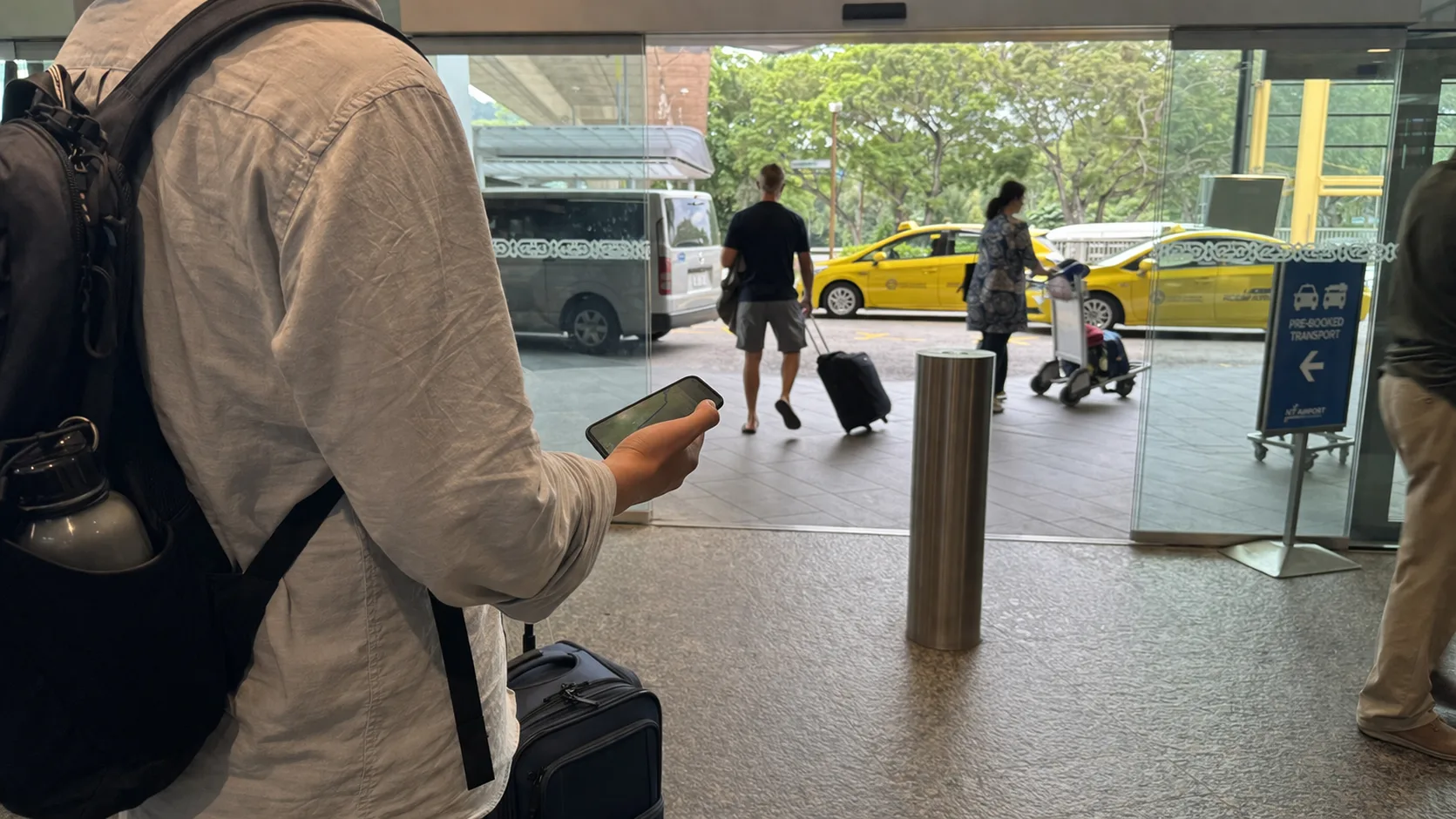
The first time I installed an Airalo eSIM, I was standing in the queue at Suvarnabhumi airport watching my checked-bag pickup crawl — and by the time I hit the exit, I had 4G running in Bangkok. No SIM tray tool. No street-vendor negotiation. No wondering if the guy at the kiosk was ripping me off.
That was the sell. But I’ve also had an Airalo plan refuse to activate in Vietnam, watched the data meter drain faster than expected through two weeks in Portugal, and sat on chat support for 36 hours waiting for a refund. This isn’t a cheerleader Airalo review — it’s what I’ve actually found after real use across SE Asia and Europe, including when I’d tell a fellow backpacker to skip Airalo entirely. The full guide that ties all these tools together is our smart travel upgrades guide — insurance, payments, VPN, eSIM, and the full system, all in one place.
Quick verdict:
Airalo is the best eSIM for most backpackers in Southeast Asia — good coverage, transparent pricing, and no airport SIM hassle. For Europe, it’s solid for multi-country trips where buying per-country SIMs would be a headache. Holafly’s unlimited plans beat Airalo if you’re a heavy data user (remote work, lots of video) in Western Europe. And in a few specific scenarios — Cambodia, rural anywhere, or ultra-tight budgets — a local SIM card still wins. Details below.
Last updated: June 2026. This post contains affiliate links. If you buy through my links I may earn a small commission at no extra cost to you. This article contains one affiliate link — Jetpac eSIM. Airalo and Holafly are reviewed editorially and are not affiliated. Full Affiliate Disclosure.
Table of Contents
- What Is Airalo?
- Airalo vs Holafly: Head-to-Head
- Airalo in Europe: What to Expect
- Airalo eSIM Southeast Asia Review: What to Expect
- When to Skip eSIM Entirely
- Pricing and Plan Guide
- Airalo eSIM Setup and Activation
- Airalo Support and Refunds: The Honest Version
- Final Verdict: Which Backpacker Should Use Airalo?
- Which eSIM Is Right for Your Trip?
- Frequently Asked Questions
What Is Airalo?
Airalo is an eSIM marketplace built as a one-stop esim for travelers — they aggregate mobile data plans from local carriers in 200+ countries and sell them through a single app. You buy a plan, scan a QR code (or use the app), and the eSIM installs directly onto your phone’s virtual SIM slot. No physical card. No unlocking required beyond your phone supporting eSIM technology.
For most travellers using an eSIM, that’s the right trade-off. Plans are data-only — you don’t get a local phone number, which means calls and texts run through WhatsApp, FaceTime, or whatever you already use. That’s fine for most backpackers — it’s how most of us communicate abroad anyway.
Plans are sold per-country or as regional packages. A regional “Asialink” plan covers multiple SE Asian countries. A “Eurolink” plan covers most of Europe. These are the ones that matter for backpackers doing multi-country routes. For a deeper look at how eSIM technology works, Wikipedia’s eSIM overview covers the technical background well.
Airalo vs Holafly: Head-to-Head
This is the comparison most people are actually trying to make. Here’s the honest version:
| Feature | Airalo | Holafly |
|---|---|---|
| Pricing model | Pay per GB (e.g. 3GB, 5GB, 10GB, 20GB) | Unlimited data plans (with throttling after threshold) |
| Best for | Moderate users, SE Asia, multi-country trips, budget-conscious | Heavy users, Western Europe, remote workers, video callers |
| Typical SE Asia 30-day cost | $12–$22 for 5–10GB regional plan | $49–$65 for unlimited regional plan |
| Typical Europe 30-day cost | $19–$35 for 5–15GB European plan | $39–$55 for unlimited European plan |
| Hotspot/tethering | Allowed on most plans (check per plan) | Allowed on most plans (check per plan) |
| “Unlimited” reality | No unlimited — you buy what you need, top up if needed | Throttled to 512kbps–1Mbps after daily threshold (typically 1–2GB) |
| Top-up process | Buy a new plan in the app, installs on same eSIM slot — fairly smooth | Buy a new plan — requires a second eSIM installation, more friction |
| Countries covered | 200+ countries, strong in SE Asia | 160+ countries, stronger in Western Europe |
| Support quality | Chat-based, 12–48hr response, refunds often as “Air Money” credits | Chat-based, similar response times, slightly better refund record anecdotally |
| App quality | Clean, reliable, good plan filtering | Functional but clunkier interface |
| Verdict | Win for SE Asia, budget trips, moderate users | Win for heavy Europe users, remote workers |
The thing about Holafly’s “unlimited” that most reviews don’t explain clearly: it isn’t unlimited at full speed. After you hit the daily threshold (which varies by plan — usually around 1GB/day in SE Asia plans, slightly more in Europe), speeds drop to around 512kbps — a real limitation that any honest holafly esim review should mention. That’s fine for WhatsApp and light browsing. It’s not fine for Google Maps loading fast in a moving car or a video call that needs to stay stable. If you’re a remote worker doing calls, factor this in.
For a typical luxury backpacker — booking accommodation, using Maps, social media, occasional video calls home — Airalo’s GB-based model usually works out cheaper and you get full speeds throughout. The math only flips if you’re consistently burning 3GB+ per day.
One other option worth knowing: Saily (formerly Bnesim) sits in a similar price bracket to Airalo for SE Asia routes. No affiliate relationship here — just worth comparing before you commit if budget is the deciding factor. If you’d rather not think about regional plans and top-ups at all, there’s a convenience-focused alternative covered later in this guide.
Airalo in Europe: What to Expect
Airalo’s Eurolink plan is the go-to esim europe option, covering most of the Schengen area and beyond — including the UK, which matters if you’re doing a western loop. Coverage quality in major cities like Barcelona, Lisbon, Paris, and Rome is genuinely good. 4G is reliable, 5G is available in most large urban centres if your phone supports it.
The multi-country logic is where Airalo earns its keep over local SIMs for European backpacking. Buying a new SIM in Spain, then France, then Italy would cost you time and money at every border. One Eurolink plan removes that entirely.
Where it gets patchy: rural areas in Eastern Europe — parts of the Balkans, rural Poland, smaller Balkan islands — can show weaker signal depending on which carrier Airalo routes through in that country. The underlying carrier changes per market and Airalo doesn’t always make this obvious. If your route is heavily off-the-beaten-track in Eastern Europe, read the individual country plan reviews in the Airalo app before buying a regional plan; sometimes a country-specific plan routes through a stronger local carrier.
In my experience, a 10GB Eurolink plan runs around $22–$28 for 30 days. That covers moderate use — Maps, booking apps, Instagram, occasional calls. If you’re working remotely and need 3–5GB/day, step up to a 20GB plan or consider Holafly’s unlimited for that leg. On the transport side, the Eurail Pass is worth a look once your data situation is sorted — it’s the other big logistics decision for a multi-country Europe route.
Airalo eSIM Southeast Asia Review: What to Expect
SE Asia is where Airalo’s esim southeast asia coverage is at its strongest. The Asialink regional plan covers Thailand, Vietnam, Indonesia, Malaysia, Singapore, Cambodia, and several other countries under one plan. In cities like Bangkok, Ho Chi Minh City, and Kuala Lumpur, expect 15–40 Mbps on 4G — enough for Maps, WhatsApp, and the occasional hotspot session.
Country-level notes from real use:
- Thailand: Strong. 4G in cities, solid signal on the popular islands (Koh Samui, Koh Tao). Rural northern Thailand can dip — carry offline maps.
- Vietnam: Good in Hanoi and HCMC. More variable in between — Ha Giang loop and some central highlands areas show weaker signal. Activation can be slower here if the local carrier is congested at busy times.
- Bali: Reliable in Seminyak, Ubud, Canggu. Weaker in the north and east of the island.
- Cambodia: This is the weak spot. Coverage in Phnom Penh and Siem Reap is workable but inconsistent. Rural Cambodia and the southern islands (Koh Rong etc.) — Airalo is patchy. A local Smart or Metfone SIM for $2–$3 will outperform Airalo here.
- Laos and Myanmar: Coverage exists but is limited. If these are major stops, buy a local SIM on arrival.
SE Asia pricing: a 10GB Asialink 30-day plan costs around $15–$18. That’s typically 40–60% cheaper than Holafly’s equivalent regional plan. For most backpackers on a SE Asia route who aren’t working remotely, Airalo wins on value here without contest.
When to Skip eSIM Entirely
Airalo isn’t always the right answer. In a few specific situations, a physical travel sim card still wins:
- Cambodia, Laos, rural Myanmar: Local SIMs from carriers like Smart (Cambodia) or Unitel (Laos) cost almost nothing, work better, and top up at any convenience store. The eSIM convenience premium isn’t worth it here.
- Longer stays in a single country: If you’re spending 3+ weeks in one place, a local SIM will be cheaper per GB than any eSIM plan.
- Ultra-tight budgets: A local SIM in Thailand runs $8–$12 for 30 days with solid data. Airalo’s regional plans carry a convenience premium over that.
- Phone with no eSIM support: Older iPhones (pre-XS), budget Androids, and some mid-range Samsungs don’t support eSIM. Check before you buy — the Airalo app has a compatibility list.
- Destinations where local data is near-free: Vietnam’s local SIMs (Viettel, Vietnamobile) offer 20–30GB for under $5. In markets like this, even the cheapest eSIM plan can’t compete on price.
Pricing and Plan Guide
Here’s where most people overpay: they grab whatever plan pops up first in the app instead of checking the three formats against their actual route. Airalo sells local (single country), regional (multi-country), and global. For backpackers, regional is almost always the right call — unless you’re staying put in one country for a month, in which case local is cheaper.
| Plan type | Best for | Typical price range | Notes |
|---|---|---|---|
| Local (per country) | Single-country stays of 2+ weeks | $5–$15 for 3–10GB | Best value per GB; inflexible for multi-stop routes |
| Regional (Asialink / Eurolink) | Multi-country backpacking routes | $15–$35 for 5–20GB, 30 days | Most relevant for typical backpacking itineraries |
| Global | Frequent travellers, mixed region trips | $25–$50+ for 5–10GB | Higher cost per GB; useful for very mixed itineraries |
How much data do you actually need? A rough guide:
- Light user (Maps, WhatsApp, booking apps, occasional social): 1–2GB/week → 5–8GB for 30 days
- Moderate user (above + Instagram, YouTube shorts, some streaming): 2–3GB/week → 8–12GB for 30 days
- Heavy user / remote worker (video calls, hotspot for laptop, streaming): 3–5GB+/week → 15–20GB for 30 days, or consider Holafly
When in doubt, buy less and top up. Airalo’s top-up process is relatively smooth — buy a new plan in the app, it stacks onto your existing eSIM without reinstalling. You don’t get a refund on unused data, so don’t over-buy on your first trip. If the idea of tracking regional plans and top-ups across a multi-country route sounds like more admin than you want, Jetpac’s automatic country-switching is worth a look before you decide (paid link).
Airalo eSIM Setup and Activation
Scan the QR code, done — that’s the entire setup instruction in most Airalo eSIM review posts. It skips the part where the QR code doesn’t scan, or the eSIM installs but shows no signal three hours later. Here’s the fuller picture, including what to do when it doesn’t work.
- Download the Airalo app. Create an account.
- Browse plans by destination — filter by region, duration, and data size.
- Purchase the plan. You’ll receive a QR code in the app and via email.
- On your phone: Settings → Mobile/Cellular → Add eSIM → Scan QR code.
- The eSIM installs and sits dormant until you arrive in the destination country (or enable it manually).
- On arrival: switch your active data line to the Airalo eSIM in your phone’s settings.
Do this at home, or at your hotel on arrival with Wi-Fi — not while fumbling at the airport. It takes 5 minutes with a stable connection. The worst time to discover your QR code won’t scan is standing in a taxi queue at midnight with a dead phone battery and a hostel booking you can’t open.
Common activation issues:
- QR code scan fails on Android: Use manual entry (Airalo provides a SM-DP+ address and activation code) — this works when QR scan doesn’t.
- eSIM installs but shows no signal: Check that data roaming is enabled for the Airalo line. This catches about half of “it’s not working” reports.
- “No network available” on arrival: Switch the eSIM off and back on. If that fails, check the APN — sometimes it needs manual input. Airalo support can provide the correct APN string for your destination.
- iPhone: eSIM not showing in Settings: Restart the phone fully (not just the app) and recheck under Settings → Cellular. If it’s still missing, contact Airalo support directly — once a profile shows as installed on their end, they usually can’t reissue it automatically, so don’t rely on deleting and reinstalling.
Airalo Support and Refunds: The Honest Version
The support question comes up in almost every airalo review, and for good reason. Airalo sits at 3.9/5 on Trustpilot as of early 2026 — not terrible, but not a company you’d describe as support-first. The most common complaints aren’t about plans not working; they’re about refunds landing as Air Money rather than card credits. Support runs on chat via the app, with response times of 12–48 hours depending on volume. Fast enough for non-urgent issues; frustrating if you’re stuck at a bus station with no data and a booking confirmation you can’t access.
The refund situation: Airalo typically refunds unused plans as “Air Money” — credit in your Airalo account — rather than back to your original payment method. Card refunds happen but require more back-and-forth and aren’t guaranteed. If the plan never activated and you can prove it, card refunds are more achievable. If it activated but underperformed, expect Air Money.
In two years of using Airalo, I’ve had one activation failure (Vietnam) and one plan that underperformed coverage-wise (Cambodia). The Vietnam refund came as Air Money within 36 hours. Not ideal, but functional if you’re a repeat Airalo user. To be fair, most of my Airalo purchases — probably 15+ at this point — activated on the first try with zero support contact needed at all; the failures are the exception, not the norm — they’re just the part most reviews skip over.
Final Verdict: Which Backpacker Should Use Airalo?
No single eSIM is right for every route — here’s the breakdown by traveler type, based on everything above:
| If you are… | Recommendation |
|---|---|
| Backpacking SE Asia (Thailand, Vietnam, Bali, Malaysia) for 2–8 weeks | Buy Airalo Asialink. Best value, reliable coverage on the main routes, simpler than buying local SIMs per country. |
| Backpacking Europe across multiple countries | Buy Airalo Eurolink if moderate data user. Switch to Holafly if you’re working remotely or burning 3GB+/day. |
| Remote worker doing video calls and hotspotting a laptop | Holafly for Europe. Airalo for SE Asia if budget matters (you’ll likely need a 20GB plan). |
| Staying put in one country for a month | Skip eSIM. Buy a local SIM on arrival — cheaper per GB, better rural coverage. |
| Heading to Cambodia, Laos, or rural anywhere | Buy a local SIM for that leg. Use Airalo for the rest of the route. |
| First solo trip, want zero connectivity stress | Airalo. Set it up at home, arrive with data running. That peace of mind is worth the slight premium over a local SIM. |
| Phone doesn’t support eSIM | Local SIM only — check your phone model before going further. |
The bottom line: Airalo has become the default connectivity system I recommend to most backpackers because it removes the biggest friction point — arriving somewhere new without data. It’s not always the cheapest option, and it has real gaps (Cambodia, rural coverage, refund policy). But for a multi-country route through SE Asia or Europe, it earns its place in the system. I’ve included it in the Connectivity Stack in the free toolkit — it’s the setup I actually use.
Which eSIM Is Right for Your Trip?
Everything above covers the general cases — answer these four quick questions for a recommendation matched to your actual route:
Find your best-fit eSIM — answer 4 questions for an instant recommendation.
If automatic border-crossing sounds more useful than juggling regional top-ups, there’s one option worth a quick look before you decide.
Jetpac — Single eSIM Install, Works Across Countries
One eSIM profile that automatically switches plans as you move between countries — no manual reinstalls, no hunting for a new QR code at each border. Best for multi-country trips where setup friction is your biggest headache, not necessarily the lowest price.
- Automatic border-crossing switching, no manual reinstalls
- From around $1/GB on popular SE Asia and Europe routes
- Free airport lounge access for delays over 60 minutes
Frequently Asked Questions
Conclusion
The practical answer for most people: buy the Airalo Asialink or Eurolink plan before your trip, install it at home, and activate it when you land. That’s it. You’ll spend five minutes on setup instead of twenty minutes at an airport kiosk, and you’ll arrive with data already running. If you end up in Cambodia or rural Laos, pick up a local SIM for a couple of dollars and switch back to Airalo when you hit the next city. If you’re doing heavy remote work in Western Europe, Holafly’s unlimited plan is the honest recommendation.
If I were flying out tomorrow, I’d still install Airalo the night before. It’s not perfect — the refund process proved that — but on value and simplicity across a multi-country route, it’s still the best esim for travel I’ve found, and the one I trust most to have data running before I’ve even cleared the taxi line.
Connectivity isn’t guaranteed everywhere covered in this guide — treat any eSIM as a convenience, not a safety net. In remote areas (rural Laos, mountain routes, parts of the Balkans) carry offline maps, know the local emergency number, and don’t plan a route that assumes data access if the region has limited network infrastructure.