Last updated: June 2026.
The gate agent in Barcelona pointed at my bag and I already knew — I’d bought the wrong backpack. Choosing the best carry-on backpack for travel is harder than it looks, not because the options are bad, but because most of them look almost identical on paper. Forty litres of “travel-optimised” nylon, straining at the seams, absolutely not fitting in the sizer. I paid the fee, watched it disappear on the belt, and spent the next four hours planning what I’d buy instead.
That was three bags ago. I’ve since traveled carry-on only through Southeast Asia and six weeks across southern Europe, and I’ve used or borrowed six of the most popular premium options. Two are excellent. Here’s which one I’d actually buy — and a decision table at the end that’ll save you the comparison rabbit hole.
If you want the full system this bag fits into — budgeting, routing, accommodation — see the luxury backpacking guide.
Some links in this post are affiliate links, including Amazon links. As an Amazon Associate, I earn from qualifying purchases at no extra cost to you. I only recommend gear I’d actually travel with.
Table of Contents
- Why Most Carry-On Backpack Articles Fail You
- Quick Verdict: Best Carry-On Backpacks at a Glance
- Best Overall: Minaal Carry-On 3.0
- The Shortlist: Four More Worth Knowing
- The Size Question: 35L vs 40L vs 45L
- Carry-On Compliance in Practice
- The System: Bag + Packing Cubes + Personal Item
- Find Your Best-Fit Backpack
- If You Prioritise X, Buy Y
- Frequently Asked Questions
Why Most Carry-On Backpack Articles Fail You
They recommend 12–15 bags equally and call every one of them “great for travel.” That’s not a verdict — it’s a list. In every travel backpack review roundup on page one right now, real decisions get buried under inclusion. The truth is that most premium options between 35L and 45L are very similar on paper. Weight varies by 400g. Capacity overlaps. Marketing is nearly identical. The meaningful differences are comfort under real load, how easy the bag is to live out of daily, and whether it survives a Ryanair gate agent on a bad day. Those things don’t show up in spec tables.
This article cuts to five picks. One winner. Real trade-offs named on every bag, including the top pick.
Quick Verdict: Best Carry-On Backpacks at a Glance
| Bag | Capacity | Weight (empty) | Airline Safe? | Comfort (loaded) | Best For | Price (approx) |
|---|---|---|---|---|---|---|
| Minaal Carry-On 3.0 ★ Top Pick | 35L | 1.45 kg | ✅ Yes | ⭐⭐⭐⭐⭐ | Best overall · comfort · aesthetics | ~$380 |
| Aer Travel Pack 3 | 35L | 1.7 kg | ✅ Yes | ⭐⭐⭐⭐ | Minimalist · premium build · durability | ~$320 |
| Nomatic Travel Pack | 40L (expandable) | 1.9 kg | ⚠️ Usually | ⭐⭐⭐ | Maximum organisation · short trips | ~$300 |
| Peak Design Travel Backpack 45L | 30–45L | 2.05 kg | ⚠️ Depends | ⭐⭐⭐⭐ | Photographers · hybrid carry | ~$350 |
| Tortuga Setout 35L | 35L | 1.55 kg | ✅ Yes | ⭐⭐⭐⭐ | Best value premium · comfort | ~$250 |
| Osprey Fairview 40L (Women’s) | 40L | 1.36 kg | ✅ Yes | ⭐⭐⭐⭐ | Women’s fit · lightweight · everyday carry | ~$180 |
Best Overall: Minaal Carry-On 3.0
The Minaal wins because it solves the two problems that actually matter in practice: it’s the most comfortable premium travel backpack under load, and it looks like something you’d carry into a boutique hotel lobby without explaining yourself.
Most 35L bags feel fine empty and start to punish you after 20 minutes walking loaded. The Minaal doesn’t. The harness is shaped properly, the load lifters work, and the back panel has enough structure to keep the bag from sagging into your lower back on a long transit day. I’ve done 40-minute walks from train stations in Barcelona and Porto fully loaded — around 10 kg — and felt significantly less wrecked than I did with my previous Aer.
The clamshell opening is good. Security lanes take seconds. You reach the laptop without unpacking the top. The internal organisation is clean without being over-engineered — there’s a place for everything, and you can find things without pulling the bag apart.
Aesthetically it’s the closest thing in this category to a bag that doesn’t read as “backpacker.” Clean lines, understated branding, neutral colourways. It works in airports, at co-working spots, and at check-in at a nicer property without looking out of place.
Who it’s not for: If you pack heavy and need 40L+, the 35L will frustrate you — this bag rewards editing your packing list. If you fly budget European airlines frequently and want to guarantee under-seat fit, the Minaal is slightly bigger than ideal for that use case.
The Shortlist: Four More Worth Knowing
The Minaal is my top pick, but it’s not the right bag for everyone. Here’s where the other four fit and who they’re actually for.
Aer Travel Pack 3 — Best Minimalist Build
The Aer is the most durable bag in this category. Ballistic nylon exterior, YKK zips throughout, and build quality that feels like it’ll outlast several years of hard travel. The design is clean without being tactical — it reads professional rather than outdoorsy.
Where it loses to the Minaal: it’s heavier empty (that ballistic nylon costs you 250g before you pack anything), and the harness is less refined under heavy load. It’s also slightly stiffer to live out of — the organisation is good, but the clamshell doesn’t open quite as flat. After carrying both on the same Europe trip, the Aer felt noticeably stiffer through the back by day three.
Best for travelers who prioritise durability and clean aesthetics over maximum comfort, and who pack light enough that the harness stiffness doesn’t become an issue.
Nomatic Travel Pack — Best Organisation
Every Nomatic backpack review says the same thing, and it’s true: it’s the most organised bag in this category — and that’s both its strength and its trap. The pockets are well-thought-out: dedicated shoe compartment, a laptop sleeve that works, enough internal structure that you could pack it in the dark. If you travel with lots of small items and hate digging, the Nomatic rewards you.
The problems: it’s heavy at 1.9 kg empty, and at 40L expanded it starts to attract attention at budget airline gates. The harness is functional but noticeably less comfortable than the Minaal or Tortuga under load. The rigidity that makes it organised also makes it less comfortable after a long walk.
Best for short trips where organisation matters more than comfort, and where you’re flying full-service airlines with consistent overhead standards.
Peak Design Travel Backpack 45L — Best for Photographers
Full disclosure: this is the one bag on this list I haven’t personally traveled with for an extended trip. I’ve handled it, packed it, and used it on day trips — but not lived out of it for weeks. I’m including it because it’s the most technically capable option for one specific reader, and leaving it out would be a real gap. If you shoot, read on. If you don’t, the size penalty isn’t worth it — skip to Tortuga.
At 45L and 2.05 kg empty, it’s heavier and larger than everything else here, and it will get flagged on budget European carriers at the gate. What earns it a place: the compression system genuinely works — it compresses to 30L for day trips and expands to 45L for longer stints — and the modular insert system for camera gear is the best carry-on solution for photographers who don’t want a dedicated camera bag taking up a separate slot.
Tortuga Setout 35L — Best Value Premium
The Tortuga is underrated because it doesn’t have the marketing budget of the other bags here. It’s the best value premium travel backpack available right now — comfortable under load, properly sized for international carry-on compliance, and better organised than the Aer at $70 less.
It’s not as refined as the Minaal, and the brand doesn’t carry the same cachet. But if you’re choosing between $250 and $380 and the difference matters to you — say, you’re also budgeting for three months of accommodation — the Tortuga is a solid bag. I’d take it over several bags that cost $50 more.
The Size Question: 35L vs 40L vs 45L
This is the question most travel backpack review articles skip past, and it’s the one that matters most before you buy the best carry-on backpack for travel. Size isn’t just about capacity — it determines your airline risk, your packing discipline, and ultimately whether you’re moving freely or managing a bag. In my experience, and from everything I’ve seen in the one-bag world, 35L is where most people land — and for good reason.
| Size | Real-world capacity | Airline risk | Best for |
|---|---|---|---|
| 30–35L | 1–2 weeks packed efficiently | ✅ Safe on all carriers | Most carry-on travelers — the sweet spot |
| 35–40L | 2–3 weeks with a good packing system | ⚠️ Low risk on most; watch budget airlines | Longer trips or heavier packers |
| 40–45L | 3+ weeks or less disciplined packing | ⚠️ Moderate — consistent risk at gates | Full-service airlines only; or checked as backup |
| 45L+ | Plenty — but you’ll likely overpack | 🚫 High — expect gate-check pressure | Not recommended as a primary carry-on strategy |
The sweet spot for most luxury backpackers is 35L. It’s compliant everywhere, forces you to pack with intention (which improves every trip), and paired with a good packing cube system handles 3+ weeks comfortably. I’ve done six weeks in Europe with a 35L Minaal and never wished for more space — I wished I’d left two things at home.
Carry-On Compliance in Practice
Published carry-on dimensions are almost never enforced uniformly, but the risk isn’t random — it clusters in specific situations. According to the FAA’s carry-on baggage guidelines, the standard maximum is 45 linear inches total, though individual airline policies vary and enforcement has tightened significantly. Note that weight limits matter as much as dimensions — most budget European carriers cap cabin bags at 10 kg total, so a 1.9 kg empty Nomatic leaves you only 8.1 kg of packing room before you’re over.
- Full flights on budget carriers (Ryanair, EasyJet, Wizz Air): gate agents actively check bags. If you board late, a 40L+ bag increases your risk significantly.
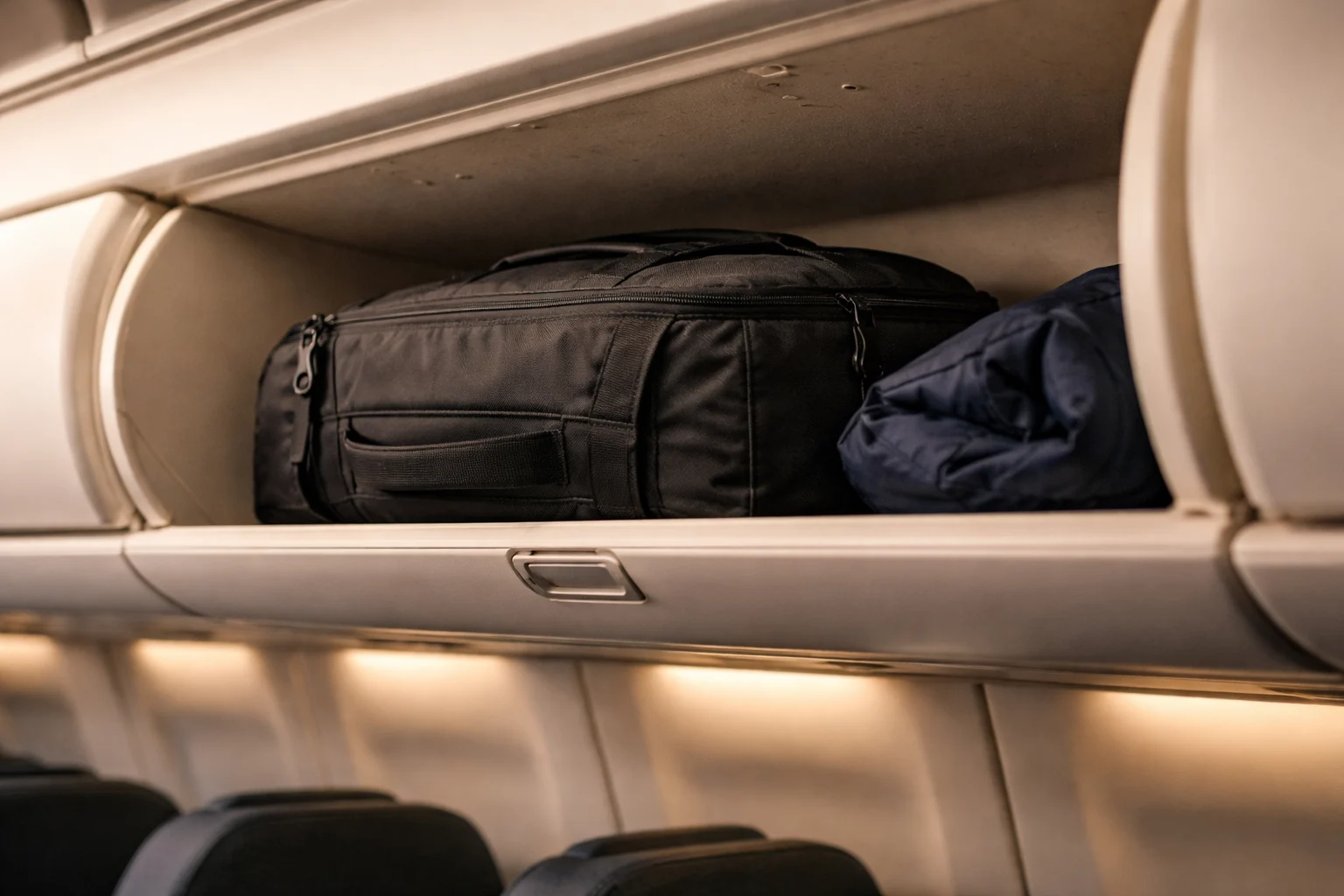
- US domestic personal item rules: most airlines define personal item as under-seat only — typically around 18 x 14 x 8 inches. A 35L travel backpack does not qualify as a personal item on most US carriers.
- Regional turboprops: overhead capacity is genuinely limited. Even airline-compliant bags get checked at the door.
- Full-service international carriers: 35L bags virtually never get checked if you board normally. The risk is close to zero.
The practical rule: if budget European airlines are part of your route, stay at 35L and board with priority boarding or as early as possible. The bag is never the problem — it’s the timing.
The System: Bag + Packing Cubes + Personal Item
The backpack is one part of what you’re building. The other two parts matter more than most people expect. Once you have the bag sorted, the next step is deciding exactly what to pack for backpacking — the full minimalist list for this travel style.
Packing cubes: These transform how a 35L bag works in practice. Without them, it feels tight and chaotic. With two or three good compression cubes, the same bag feels organized and surprisingly spacious — they reduce bulk without reducing what you bring. Eagle Creek Pack-It Compressors and Osprey Ultralight Packing Cubes are the two I keep recommending. Two medium cubes and one small is the most functional combination for a 35L bag — avoid the big cube sets that ship as full kits.
Personal item backpack: If you’re flying budget airlines and want to maximise carry-on capacity, a small personal item backpack (20–25L) paired with a 35L carry-on is the most efficient system. The personal item sits under the seat; your carry-on goes overhead. The Aer City Pack Pro and the Osprey Daylite Plus both work well as a personal item backpack in this role. The combined system gives you 55–60L of total carry-on capacity with no checked luggage risk.
Once you have the bag, the next step is building the full system. The carry-on only travel system covers airline rules, packing strategy, laundry logistics, and what to do when a gate agent starts measuring bags.
Every bag choice is a trade-off — and your specific travel mix changes which one matters most. Use the tool below to skip the manual comparison.
Find Your Best-Fit Carry-On Backpack
Answer 4 quick questions — get one specific recommendation.
How long are your typical trips?
What matters most to you?
Which airlines do you fly most?
Do you carry camera gear or need a hybrid bag?
If You Prioritise X, Buy Y
| If you prioritise… | Buy this | Why |
|---|---|---|
| Best overall balance | Minaal Carry-On 3.0 | Comfort + aesthetics + compliance in one bag |
| Maximum comfort under load | Minaal Carry-On 3.0 | Best harness system in this category |
| Maximum durability | Aer Travel Pack 3 | Ballistic nylon, best build quality |
| Maximum organisation | Nomatic Travel Pack | Most pockets, best internal structure — accept the weight |
| Camera gear or hybrid use | Peak Design 45L | Compression system + photo insert compatibility |
| Best value under $270 | Tortuga Setout 35L | Comparable comfort to Minaal at $130 less |
| Boutique hotel aesthetic | Minaal or Aer | Both read premium, not student backpacker |
| Budget airline carry-on certainty | Any 35L on this list | Board early — no exceptions |
If budget is a real factor, the Osprey Farpoint and Fairview are the strongest under-$200 option — carry-on compliant, stowaway harness, and built to Osprey’s usual standard.
Best ergonomics under $200: Osprey Farpoint / Fairview 40L — adjustable harness, stowaway suspension, Osprey’s lifetime warranty.
Under 1.4 kg empty, carry-on compliant, and the adjustable harness system fits a wider range of torso lengths than any boutique brand at this price. Farpoint is men’s-fit; Fairview is women’s — same spec, same price.
Prices correct as of June 2026 — check current pricing before buying.
Frequently Asked Questions
Conclusion
Most people searching for the best carry-on backpack for travel want to stop researching and just buy the right thing. The Minaal Carry-On 3.0 is that bag for most — the one bag travel backpack that delivers comfort, compliance, and aesthetics without compromise. If the price is a sticking point, the Tortuga Setout 35L is a genuine alternative, not a consolation. Pick one, build your capsule wardrobe for travel around it, and move.
Recommendations are based on personal travel experience with these bags across multiple trips. Some links are affiliate links — commissions help keep this site running at no extra cost to you.