Last updated: June 2026.
The night I paid $12 for a Bangkok dorm bed and got zero sleep because of a 3am card game two bunks over, I started Googling “what is a boutique hotel” — and hit a wall of vague answers. Every article either listed “10 dreamy boutiques in Lisbon” or murmured about “curated experiences.” None answered what I actually needed: is a boutique hotel worth the extra $30–50 a night for someone who travels like I do? After staying in a lot of both, here’s a straight answer, and a decision framework you can use before every booking.
Most articles stop at the definition. The more useful question is where boutique wins, where it doesn’t, and when you’re simply paying extra for nicer wallpaper. This post covers the full comparison — boutique vs hostel private vs dorm vs villa split — real price benchmarks by city, and how to find cheap boutique hotels that are actually worth the money. It sits within the broader backpacking hacks system.
This post contains affiliate links. If you book through our links, we may earn a commission at no extra cost to you. Learn more.
Table of Contents
- What Is a Boutique Hotel — The Practical Definition
- Boutique vs Hostel vs Villa Split: The Real Comparison
- Which Accommodation Is Right for Your Trip?
- Real Price Ranges by City
- When a Boutique Hotel Is Worth It
- When to Skip the Boutique
- How to Find a Real Boutique Without Overpaying
- Frequently Asked Questions
What Is a Boutique Hotel — The Practical Definition
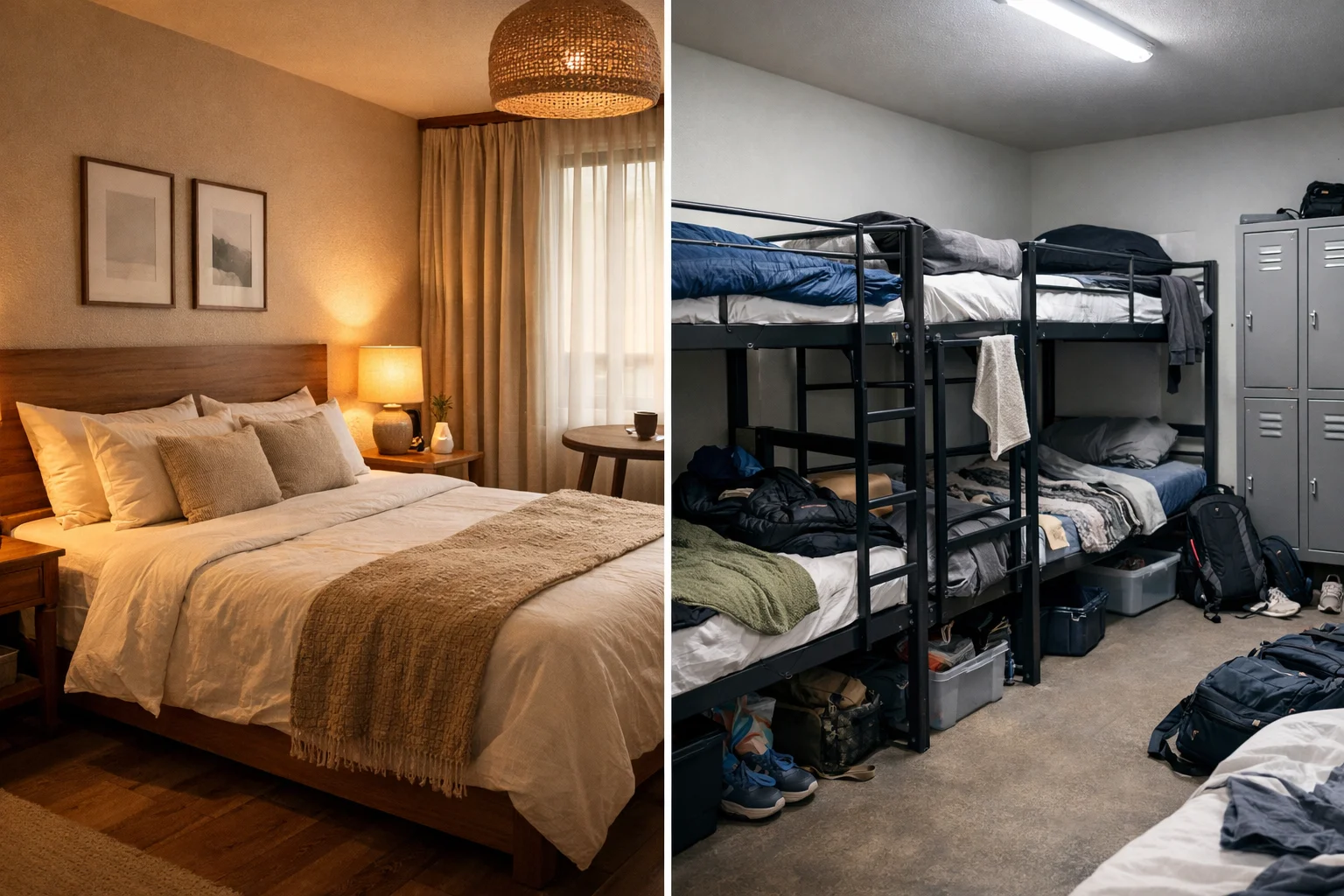
So what does boutique hotel actually mean in practice? The term is unregulated — any property can use it, which is exactly why Googling “what is a boutique hotel” returns so much marketing noise. A hotel that genuinely earns the label tends to share most of these traits:
- Small: Usually 10–80 rooms. Rarely more than 100. Small enough that staff actually remember your name.
- Independently owned (or feels that way): Not a Marriott sub-brand. No franchise playbook. Decisions get made by the owner, not a regional manager in another city. According to Wikipedia’s overview of boutique hotels, the concept emerged in the 1980s specifically as a reaction against standardised chain hotel experiences.
- Designed with intention: Local materials, a specific aesthetic, something that reflects the neighbourhood or culture. Not the same beige carpet as the Ibis down the street.
- Location-conscious: Usually in the interesting part of town — old city, creative district, converted building — not next to the airport.
- Service that scales with size: Fewer rooms means staff can actually pay attention. Good boutiques feel like someone cares. Bad ones are just small.
What it’s not: a small hotel with “boutique” in the name, a chain property with artsy wallpaper, or any place charging $200+ a night that treats backpackers as an afterthought. Worth noting: “boutique-adjacent” chains like citizenM and The Hoxton use the aesthetic without the independent ownership — they’re a legitimate middle ground if you want consistency, but they’re not boutique in the traditional sense.
Is “Boutique” Just Marketing?
Honestly? Sometimes. The word is unregulated, so plenty of properties use it purely for SEO. The difference shows up in the reviews — a real boutique gets comments about the owner recommending a local restaurant, the handmade headboard, the rooftop nobody else knows about. A fake boutique gets “nice photos, mediocre stay.” The checklist further down will help you tell the difference before you book.
Boutique vs Hostel vs Villa Split: The Real Comparison
This is the comparison nobody makes — because most articles assume you’re choosing between a boutique hotel and a luxury hotel. You’re not. You’re choosing between this and a hostel private room, or maybe an Airbnb villa split with friends. Here’s how they actually stack up.
| Factor | Boutique Hotel | Hostel Private Room | Hostel Dorm | Villa Split (Airbnb) |
|---|---|---|---|---|
| Price (solo) | $45–100/night | $25–55/night | $10–25/night | $20–50/night* |
| Price (per person, couple) | $22–50/night | $25–55/night | $10–25/night | $15–35/night* |
| Sleep quality | High | Medium (still hostel noise) | Low–Medium | High |
| Privacy | Full | Full (room only) | None | Full |
| Social atmosphere | Low–None | Medium | High | Your group only |
| Local character | High | Low–Medium | Low | Variable |
| Remote work | Good (quiet, often desk) | Difficult (shared spaces) | Poor | Best (kitchen, space) |
| Flexibility | Medium (fixed checkout) | Medium | High | Low (min stay, cleaning) |
| Best for | Recovery nights, couples, remote work, 3+ nights | Solo travelers who want some social | Tight budget, social first | Groups of 3+, 5+ night stays |
*Villa split price assumes 3–4 people sharing. Per-person cost shown; drops further with larger groups.
Once you’ve seen how the options stack up, use the tool below to get a personalised recommendation.
Which Accommodation Is Right for Your Trip?
Answer the 3 questions below — your recommendation updates automatically.
1. How many people are you traveling with?
2. How many nights are you staying?
3. What matters most on this trip?
Whichever option the tool points you toward, the price tables below will tell you exactly what that choice costs, city by city.
Real Price Ranges by City
Price ranges shift a lot by city, season, and neighbourhood. The numbers below come from a mix of stays I’ve booked personally and ongoing price-tracking for the cities we cover most. Here’s a realistic baseline for backpacker-friendly boutique hotels — not the $200 design hotels, not the sketchy ones using “boutique” loosely:
| City | Boutique Hotel (budget range) | Hostel Private Room | Hostel Dorm |
|---|---|---|---|
| Lisbon | $55–90/night | $35–55/night | $18–30/night |
| Barcelona | $65–110/night | $40–65/night | $20–35/night |
| Bangkok | $35–70/night | $20–40/night | $8–18/night |
| Bali (Ubud/Canggu) | $40–80/night | $18–35/night | $8–15/night |
| Europe (general) | $55–120/night | $30–60/night | $15–30/night |
Prices based on 2025–2026 data.
- Bangkok: Best value for boutique in SE Asia. Boutique hotel Bangkok options at $40–50/night get you real character that beats any hostel private room at the same price point.
- Lisbon: The gap between hostel private and boutique has narrowed — boutique hotel Lisbon options (Mouraria, Intendente) start around $55, only $15–20 more than a decent private room.
- Barcelona: Toughest market. Boutique hotel Barcelona options in central neighbourhoods run $70+. Villa splits with a group become more competitive here for stays of 4+ nights.
- Bali: Watch the drift toward resort territory in Seminyak and Ubud. Boutique hotel Bali options under $80 in Canggu or quieter Ubud streets is genuinely achievable — just stick to independent guesthouses and smaller properties.
When a Boutique Hotel Is Worth It
Not every night needs to be a boutique. But I’ve had stays that changed the whole feel of a city — and they were almost always the boutique nights. Here’s when it’s clearly the right call:
- You’re staying 3+ nights in one city. The nightly premium spreads out, you actually get to enjoy the space, and the location quality compounds. A boutique in Lisbon’s Alfama neighbourhood at $65/night for four nights beats a hostel private room at $40 when you factor in sleep quality and recovery.
- You’re traveling as a couple. The per-person math flips — see the breakdown below.
- You’re remote working. Shared hostel spaces are brutal for focus. A boutique with a quiet room, a real desk, and reliable WiFi pays for itself in productivity — especially true in SE Asia, where the per-night cost is low enough that the comfort upgrade pays off.
- You’re burned out from dorm life. After three weeks of shared bathrooms and 6am alarms from other people’s flights, one good night’s sleep in a real room resets everything. I started building in one boutique night every 5–7 days as a deliberate recovery stay — and my trips got noticeably longer as a result.
- You’re in a city with strong boutique value. Bangkok and Bali offer genuinely good options under $60 — sometimes under $50. At that price, the upgrade is obvious.
When you’re ready to search, one filter separates boutiques and guesthouses from chain hotels instantly.
Find Boutique Options Worth the Upgrade
Sort by review score (8.0+) and use the property type filter to surface independent boutiques and guesthouses. Add free cancellation when dates are flexible — better options often open up closer to your window.
When to Skip the Boutique
The flip side matters just as much. Here’s when I’d skip the boutique entirely and put the savings toward something that matters more:
- One-night transit stop. You’ll sleep six hours and leave. Dorm or hostel private is fine — save the upgrade for a city you’re actually staying in.
- Ultra-budget stretch. If you’re making $800 last a month, the $30–50 nightly difference adds up to real money. Dorm it.
- You’re in social mode. If meeting other travellers is the point of the trip, boutiques offer almost none of that. Hostel common rooms win here every time.
- You’ll barely be in the room. Long hiking days, all-day tours, early starts — don’t pay boutique rates for a bed you’re not using.
How to Find a Real Boutique Without Overpaying

The word “boutique” in a hotel name means nothing. After booking enough of both the real ones and the disappointing ones, here’s what I actually check:
- Under 60 rooms (check the listing — larger properties often bury this)
- Review score 8.5+ on Booking.com with 100+ reviews
- Reviews mention specific staff by name — a sign of genuine small-property service
- Photos show real rooms, not renders — look for natural light, actual furniture, no stock photography energy
- Neighbourhood is interesting — not airport strip, not tourist trap block
- Listed amenities are specific, not generic (“roof terrace with city view” vs “outdoor space”)
- No resort fees in the fine print — common in Bangkok boutiques especially
- Recent reviews (last 3 months) are consistent — older boutiques sometimes slip
If you’re only going to steal one tactic from this checklist, make it this:
Timing matters too. Cheap boutique hotels in Europe and SE Asia are most accessible in shoulder season (October–November, February–March) drops prices 20–35% in most cities. Lisbon and Barcelona boutiques that run $80/night in summer often drop to $55–60 in November. Same room, same quality, 30% off. If you’re traveling with a group instead of solo or as a couple, that same seasonal discounting applies even harder to villa splits — see the Bali villa rental guide for the method.
Frequently Asked Questions
Conclusion
“Boutique hotel” gets thrown around a lot — but once you know what it actually means, it becomes a useful category. For the right trip type (3+ nights, couple, remote work, recovery stay), a boutique hotel Europe or SE Asia pick often delivers more value than a hostel private room at a surprisingly small price difference. The key is knowing when to upgrade and how to spot a real one. These days, when a night starts looking like another $12 Bangkok dorm and a 3am card game, I already know exactly what to book instead.
If you want the whole accommodation-and-budget system as an interactive companion instead of piecing it together post by post, the Luxury Backpackers Toolkit walks through it end to end.