Last updated: June 2026.
I was sitting on a plastic chair in a Chiang Mai guesthouse at 11pm, too wired to sleep, too tired to go out. The dorm room behind me had six snoring strangers, one broken air-con, and a bathroom I’d been avoiding since check-in. I’d paid $9 for the privilege.
Three days later, in the same city, I paid $38 for a private room with a real bed, working AC, and a bathroom I didn’t have to negotiate. I slept nine hours. The next day I was sharp, motivated, and actually enjoyed myself.
The difference wasn’t $29. It was the difference between a trip I was enduring and a trip I was living.
This post is the full framework: what to spend, what to skip, how to find good accommodation without overpaying, how to move between places without suffering, and how to pack so everything works. Southeast Asia is the working example throughout because that’s where the comfort-to-cost ratio is hardest to ignore once you see it. If you want the whole system as an interactive step-by-step companion, the free Luxury Backpackers Toolkit covers every part of it in one place.
Calculate Your Luxury Backpacking Budget
Table of Contents
- What Luxury Backpacking Actually Is
- The Core System: Where to Spend, Where to Save
- Accommodation: What $30–65 Gets You in Southeast Asia
- Transport: When to Pay, When to Skip
- Food: Eating Well Without the Tourist Tax
- Packing: The Carry-On Framework
- For First-Timers: What to Expect and What to Avoid
- The System in Practice: 2 Weeks in Thailand and Vietnam
- The Splurge vs. Save Cheat Sheet
- Daily Budget Calculator
- Frequently Asked Questions
- Where to Go Next
What Luxury Backpacking Actually Is
Let’s define it properly, because most articles get this wrong.
This style of travel means independent backpacking with deliberate comfort upgrades — staying in private rooms instead of dorms, taking comfortable transport instead of the cheapest option, eating one decent meal a day instead of every meal from a street cart. You’re still moving between places independently, carrying your own bag, routing yourself, making your own decisions. You’re just not suffering while you do it.
The sweet spot sits between the $15 dorm and the $200 hotel: that $35–80/night range, in Southeast Asia, gets you a clean private room, working AC, often a pool or rooftop, in a walkable neighborhood — all without touching resort pricing. “Flashpacker” and flashpacker travel get used to describe something similar, but they’ve become Instagram-coded in a way that misses the point. This isn’t about signaling. It’s about traveling at a pace you can sustain.
The Core System: Where to Spend, Where to Save
Most travel advice is a list of tips. Tips don’t build comfort — systems do. This is the core framework behind affordable luxury travel: not spending more overall, but spending in the right places.
The non-negotiables (spend here)
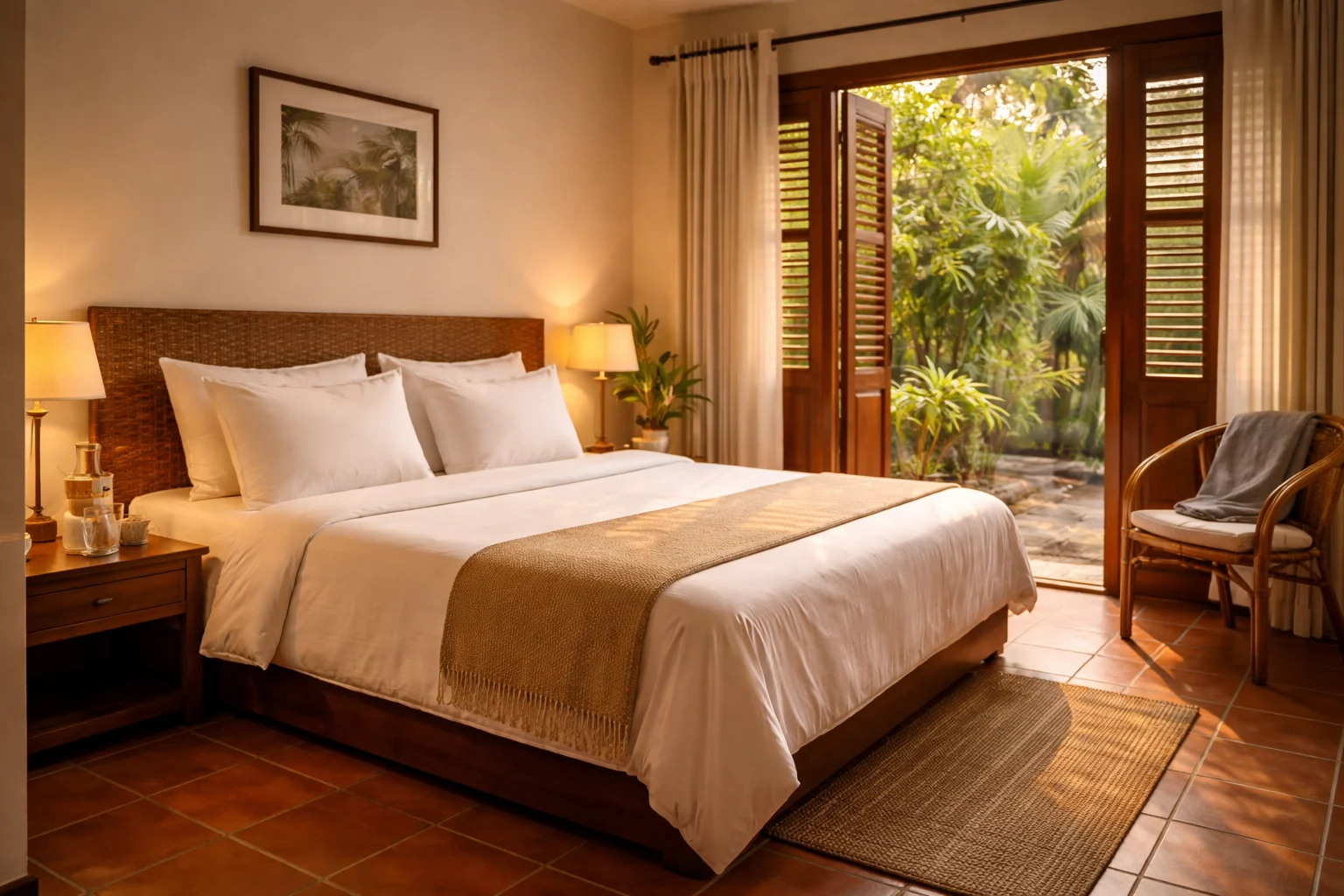
Sleep. A bad night’s sleep doesn’t just ruin the next morning — it compounds. After three nights of broken sleep in a loud dorm, you’re irritable, making bad decisions, and not enjoying the trip you planned for months. Private room, working AC, a bed that doesn’t feel like a shelf. Budget $35–65/night in Southeast Asia and you can almost always get this.
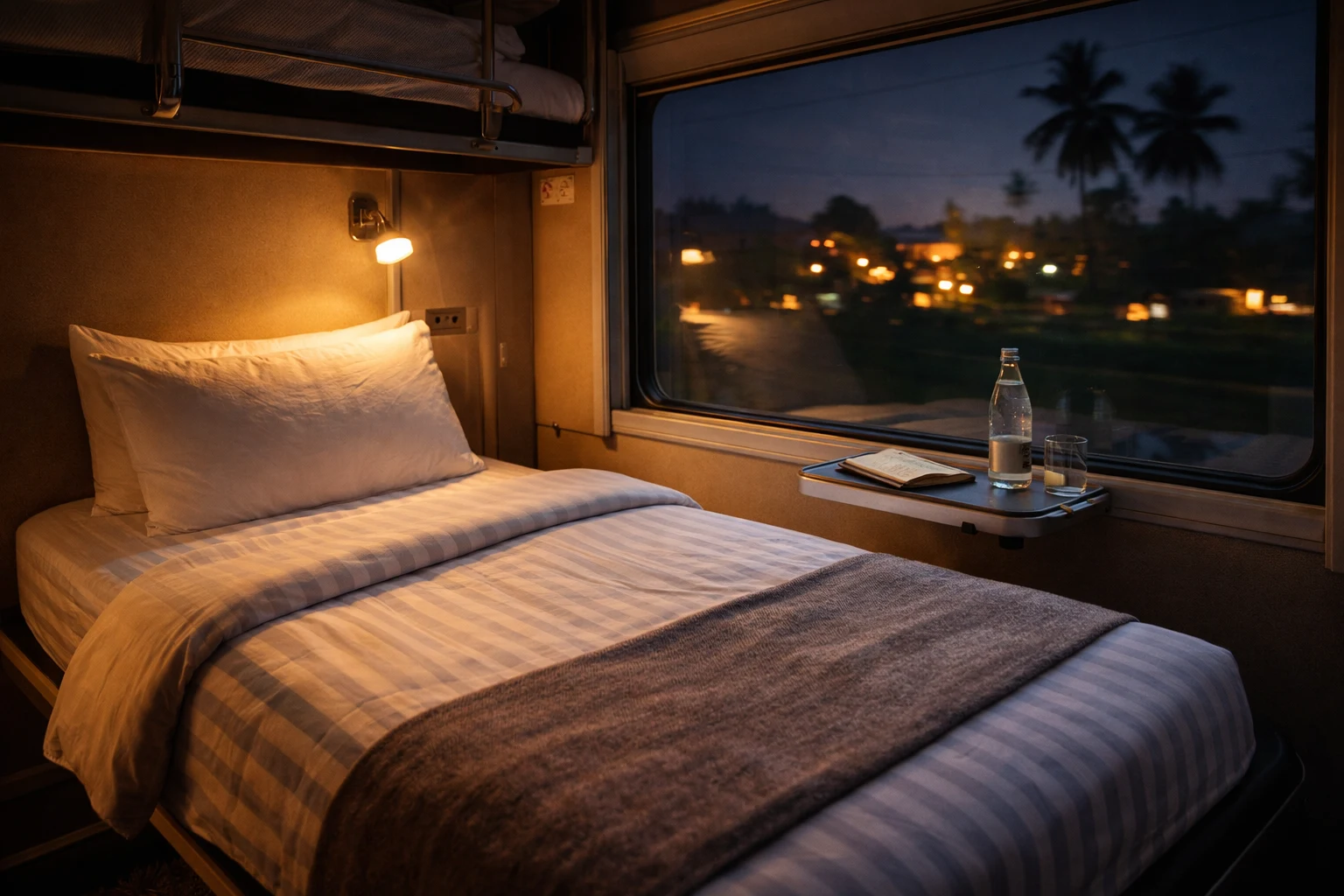
Transport on long legs. The overnight bus from Hanoi to Hue is 12 hours. Taking the cheapest option to save $15 means arriving destroyed. Pay for the sleeper train, the budget flight, or the overnight bus with actual berths. The rule: under 4 hours, take whatever’s cheap. Over 4 hours, pay for comfort.
Safety and location. Staying in a sketchy neighborhood because the room is $8 cheaper is a false economy. Central, walkable areas mean less transport spend, less wasted time, and more confidence moving around at night.
Where you can safely cut
Food — mostly. Street food and local restaurants in Southeast Asia are excellent. Eating every meal at tourist restaurants because they have English menus costs 3–4x more and is often worse. One decent sit-down meal per day, the rest local, is the move.
Activities. The temple entrance fee is $5. The tour that takes you to the same temple is $45. Do your own routing when the activity is straightforward. Pay for guides when the experience genuinely needs one — certain jungle treks, cooking classes, historical sites where context transforms the visit.
Location prestige. The boutique guesthouse on the most famous tourist street adds $30–50/night for noise and crowds. The same quality room three blocks away costs less and is quieter. Always check walking distance on Google Maps before assuming you need to be dead-center.
Accommodation: What $30–65 Gets You in Southeast Asia
For backpacking Southeast Asia on a comfort budget, here’s what you’re actually looking at by country. These are private rooms with AC — the baseline for this style of travel:
| Country | Budget private room | What you actually get |
|---|---|---|
| Thailand | $30–55 | Clean private room, AC, often pool access, good wifi, central location |
| Vietnam | $25–50 | Private room, AC, often breakfast included, en-suite bathroom |
| Cambodia | $20–40 | Guesthouse private, AC, basic but clean, good areas in Siem Reap/Phnom Penh |
| Bali (Indonesia) | $30–60 | Private room, often private bathroom, sometimes small pool, lush settings |
| Malaysia | $35–60 | Clean guesthouse private, AC, better bathrooms, central KL or Penang |
| Laos | $20–40 | Guesthouse private, AC, quieter neighborhoods, excellent value |
How to find it: filter on Booking.com or Agoda by “private room,” sort by review score (aim for 8.0+), then check photos manually. The photos will tell you more than the description. Look for natural light in the room shot, a bathroom that isn’t a closet, and a bed that doesn’t look like it was rescued from storage. Places that offer both dorm beds and private rooms are usually well-run — they understand what independent travelers need and price private rooms fairly rather than treating them as luxury add-ons.
Group villa splits — the upgrade that changes the math
If you’re traveling with even one other person, villa splits in Bali, Koh Samui, or Chiang Mai are worth knowing about. A villa with a private pool that costs $120/night splits to $60 per couple or $40 per person in a group of three. You get more space, a kitchen, and a pool — paying the same or less than a mid-range hotel room. Search Airbnb or Booking.com with “private villa” filtered by number of guests. The value-to-experience ratio at this price point in SE Asia is genuinely hard to beat.
Transport: When to Pay, When to Skip
Transport is where budget travelers bleed money in exhaustion rather than cash. The math looks good until you factor in recovery days, missed mornings, and arriving somewhere destroyed at 6am.
| Journey length | Default choice | Notes |
|---|---|---|
| Under 3 hours | Cheapest option, including minibus | Not long enough to matter much |
| 3–6 hours | Comfortable bus or shared van | Pay $5–10 more for AC and assigned seating |
| Over 6 hours | Train sleeper, flight, or premium overnight bus | Saving $20 here costs you a day |
| Overnight (any length) | Sleeper train or budget flight | Overnight buses only work with actual berths — verify before booking |
Budget flights in Southeast Asia change the calculation entirely — I’ve paid $18 to fly Bangkok to Hanoi when the overnight bus would’ve cost $25 and taken 18 hours. AirAsia, VietJet, and Cebu Pacific regularly run routes for $25–55 that would otherwise mean 10-hour bus journeys. Check flight prices before defaulting to overland. Sometimes flying is the smartest move — pay $40, skip 10 hours of bus, arrive ready to explore. For overland bookings, 12go.asia is the standard resource for comparing buses, trains, and ferries across the region.
In-city transport: Use Grab across most of Southeast Asia. It’s the regional equivalent of Uber — metered, safe, cashless if you set it up, and dramatically cheaper than negotiating with tuk tuk drivers who’ve clocked you as a tourist. For distances under 20 minutes, walk. The exercise and the ground-level view of a neighborhood are both worth it. These aren’t glamorous backpacking hacks, but they’re the ones that actually save money day-to-day.
Food: Eating Well Without the Tourist Tax
The problem isn’t the food — Southeast Asia is extraordinary to eat in at every price point. The problem is the tendency to default to tourist-facing restaurants because they’re easier to navigate.
The pattern that works: street food and local spots for two meals a day, one slightly better restaurant once daily. In Thailand, Vietnam, and Cambodia, this means breakfast and lunch from markets, food courts, or places with plastic stools and a crowd of locals — $2–5 a meal. Dinner at a proper restaurant with a cold beer — $8–15. Total food spend: $15–25/day, with real variety and quality.
How to find the good local spots: Google Maps. Search the name of a specific dish you want, filter by rating, and look at photos. If the photos are of the food rather than the decor, that’s a good sign. Spots with hundreds of reviews from non-English names consistently outperform places with a 4.8 rating and reviews that mention “great for tourists.” In my experience, the best meals on any SE Asia trip come from following a crowd of locals into a place with no English sign and pointing at whatever the table next to you ordered.
The one splurge worth making: one cooking class or food tour per destination. They typically run $30–60 and reorient your whole relationship to the food scene in that city. You’ll spend the rest of the trip eating better because of it.
Packing: The Carry-On Framework
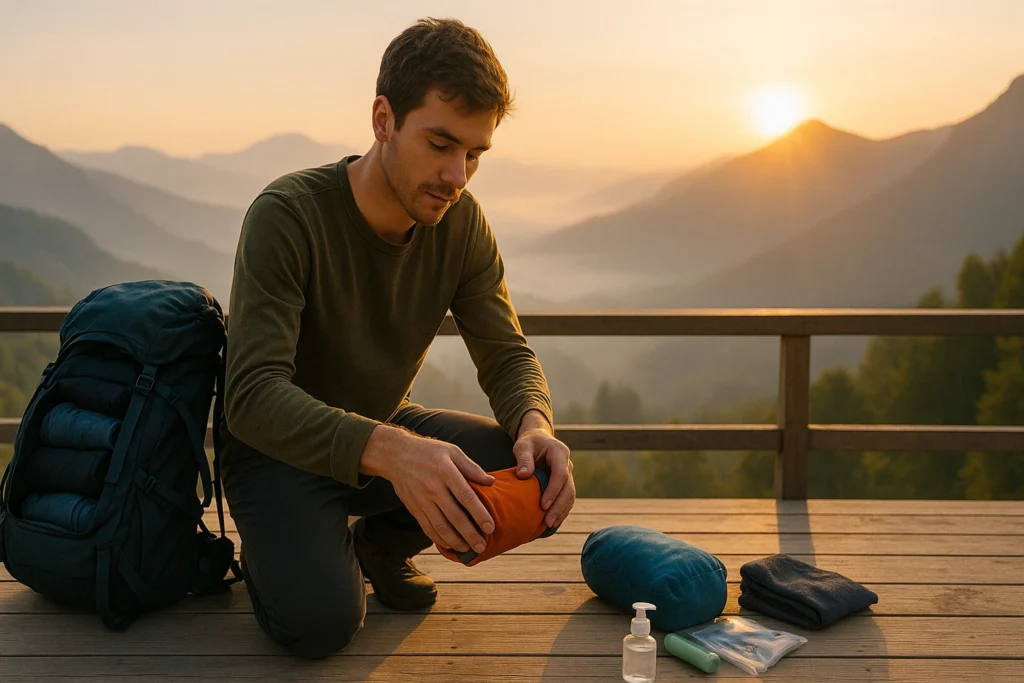
Heavy bags ruin trips — not dramatically, but gradually. Extra weight makes transport worse, check-ins slower, and spontaneous decisions harder. Traveling with a carry-on-sized bag (40–46L) means you never check luggage, move faster, and never become the person hauling 20kg up four flights of stairs with no lift.
The philosophy: pack for the hardest day, not the average day. Most days in Southeast Asia you’ll be in warm weather in light clothes. But you’ll have one day on a mountain, one cold overnight bus, one dinner that’s not a street stall. Pack one layer for those days. Don’t pack for a version of the trip where every day is the hard one. Beyond that, the real comfort gains come from what you leave out, not what you add — and most backpacking hacks for long-term travel follow the same logic.
What actually increases comfort (in order of impact)
- A pack with a proper hip belt. The difference between a $60 bag and a $160 bag is real after 4 hours of wearing it. The Osprey Farpoint 40 (and newer equivalent models) remains the reliable mid-range pick among carry-on backpacks for travel. A hip belt distributes weight off your shoulders — non-negotiable for anything over 20 minutes of walking. I’ve done both and the cheap bag turns into a liability by week two.
- A compact inflatable neck pillow. For overnight transport. Nothing turns a rough bus into a survivable one faster.
- A simple packing cube system. Not because it saves weight — it doesn’t — but because you can find things without unpacking everything. Three cubes: tops, bottoms, everything else.
- Merino wool or moisture-wicking base layers. 2–3 t-shirts, one long sleeve. They dry fast, resist odor, and work in cold AC as well as heat. Uniqlo Airism and Icebreaker merino are both solid. Skip cotton. If you’re building a packing list around this, a travel capsule wardrobe takes the fabric decisions further.
- A 20,000mAh power bank. You’ll use this more than almost anything else you pack. One day navigating SE Asia without power is enough to convince you.
For a full breakdown of what’s worth buying versus what’s marketing noise, the best travel accessories guide covers every category.
What increases misery
- “Just in case” formal shoes that weigh 800g and never leave the bag
- Three books (use a Kindle or your phone)
- A full-size towel — most decent accommodation provides one; pack a quick-dry travel towel for the exceptions
- More than 7 days of clothing for a 3-week trip — laundry in SE Asia costs $2–4/kg with 24-hour turnaround
For a category-by-category packing list — including what most people forget and what they definitely don’t need — what to pack for backpacking has the full breakdown.
For First-Timers: What to Expect and What to Avoid
If you haven’t done independent travel in Southeast Asia before, a few things worth knowing upfront. Most backpacking tips for beginners focus on gear or booking apps — but the real learning curve is mental, not logistical.
It’s not as chaotic as it looks in YouTube vlogs. Vlogging incentivizes drama. The reality of booking a guesthouse, taking a Grab, and navigating a market is closer to any city you’ve visited than to the chaos that makes good content. You’ll find your footing within 48 hours — usually sooner. After my first solo night in Bangkok I was booking street food by pointing and using Google Translate to read menus. It works.
Visas are usually straightforward — but do them in advance. Thailand offers visa exemption for most Western passports (30 days). Vietnam requires an e-visa ($25, easy online, allow 3–5 business days). Cambodia has an e-visa too ($36). For the most current entry requirements, the CDC Travelers’ Health destination pages are a reliable starting point alongside your country’s foreign travel advisory.
Connectivity is excellent. Buy a local SIM at the airport on arrival. Typical cost: $5–12 for 30 days with 15–30GB data. AIS in Thailand, Viettel in Vietnam, and Smart in Cambodia are all reliable. eSIMs via Airalo work too if you’d rather skip the physical SIM swap.
Get travel insurance before you go. For SE Asia, a policy covering medical evacuation, trip cancellation, and activity cover typically runs $40–80 for two weeks. It’s easy to skip. It’s the one thing you can’t fix retroactively.
The biggest beginner mistake: over-scheduling. Booking a new city every two nights for three weeks means spending most of your time in transit and logistics. Plan anchor cities with 4–7 nights each, use day trips from there. You’ll see more and feel less rushed.
The second biggest mistake: no buffer days. Something will go sideways — a delayed bus, a place you want to stay longer, a minor illness. One unplanned day per week means those things are course corrections, not emergencies.
The System in Practice: 2 Weeks in Thailand and Vietnam
Here’s how everything above fits together on a real trip. This is a working 14-day loop, not a dream itinerary. For a deeper look at the region itself — cities, timing, costs — the backpacking Southeast Asia guide covers the full picture.
| Days | Location | Accommodation | Transport in | Daily budget (excl. transport) |
|---|---|---|---|---|
| 1–4 | Bangkok | Private room, guesthouse near BTS, $38–48/night | Fly in | $55–70 |
| 5–8 | Chiang Mai | Private room, Old City area, $35–50/night | Budget flight (~$45, 1hr) | $50–65 |
| 9–11 | Hanoi | Private room, Old Quarter guesthouse, $28–45/night | Budget flight (~$50, 2hrs) | $45–60 |
| 12–14 | Ha Long Bay / Ninh Binh | 1-night bay cruise ($85–120 all-in) + guesthouse $25–35 | Shuttle bus ($8, 3.5hrs) | $60–80 (cruise day) |
Prices based on 2025–2026 data — verify current rates on Booking.com or Agoda before planning.
Total accommodation: ~$560–700 for 14 nights
Total transport: ~$200–280 (flights + in-city)
Total food + activities: ~$400–550
Grand total excluding flights from home: roughly $1,160–1,530 for 14 days.
That’s $83–110/day all-in for two weeks of comfortable, private-room travel across two countries, including a Ha Long Bay cruise. Not suffering. Actually comfortable. Notice where the money went: almost half the budget bought recovery, flexibility, and one proper experience — not resorts or prestige. For the best prices on this route, May–June and September–October hit the sweet spot — post-peak crowds, lower accommodation rates, and manageable weather in both countries. Running the same system through Europe? The Europe backpacking budget maps what these numbers look like by country.
The Splurge vs. Save Cheat Sheet
| Category | Save (good enough) | Splurge (worth it) |
|---|---|---|
| Accommodation | Private guesthouse room, $30–50 | Villa split with pool for 3+ people |
| Transport (short) | Local bus, Grab, minivan | — |
| Transport (long) | — | Budget flight or sleeper train |
| Food (daily) | Street food, local spots, $3–6/meal | One restaurant meal/day, $10–18 |
| Activities | Self-guided temples, beaches, markets | One cooking class or guided trek per city |
| Experiences | Skip generic day tours | One signature experience per destination (bay cruise, floating market, river boat) |
| Bag | Decent 40L pack, $80–120 | — |
| Clothing | Airism or similar, 5–6 pieces | 1–2 merino pieces if you run cold |
The calculator below turns your specific comfort choices into a daily number — run it against your actual planned trip.
Daily Budget Calculator
Select your comfort level for each category to see a realistic daily spend.
If you're still weighing whether this style of travel makes sense for your situation, these are the questions readers ask most often.
Frequently Asked Questions
Where to Go Next
Deliberate, not accidental — that's the whole idea. Every guide below goes deeper on one part of the system:
- Backpacking tips for beginners — if this is your first time and you want the full beginner walkthrough
- Affordable luxury vacation guide — how to travel in comfort without the price tag
- Best carry-on backpack for travel — the luxury backpacker's pick
- What to pack for backpacking — the luxury minimalist packing list
- Capsule wardrobe for travel — look like a luxury backpacker with one bag
- Best travel accessories for backpackers — for backpackers who refuse to rough it
- Backpacking hacks and comfort upgrades — practical upgrades that make every trip smoother
- Luxury backpacking Southeast Asia guide — the complete system for SE Asia on your terms
In the meantime, the budget calculator above is a good place to start — plug in your travel style and see what the numbers actually look like before you book anything.
The goal isn't to travel comfortably. It's to travel long enough, comfortably enough, that you stay curious instead of burned out.
This guide draws from years of independent travel across Southeast Asia — dozens of guesthouses, overnight buses that actually worked (and ones that didn't), street meals that changed how I eat on the road, and real budgets that let me keep going month after month without burning out. All recommendations come from direct experience, not sponsored placements or commission incentives. Some links may be affiliate links, and if I recommend it, it's because it genuinely improved my trips — not because it pays better. Prices and availability shift; always double-check current details yourself.